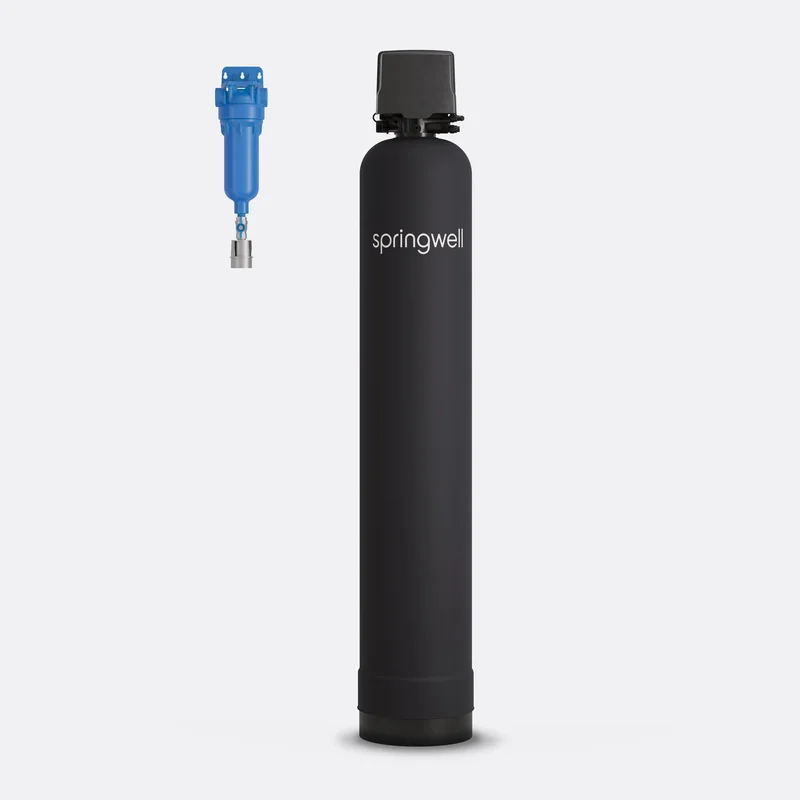
Cloudy water, grit or sand
NuisanceWhat you'll notice: Cloudy, milky or tea-colored water that clears when it sits; Grit, sand or dark flakes in aerator screens, toilet tanks and the bottom of a glass
Treat with: Spin-down (centrifugal) filter
This page contains affiliate links. If you buy through them we may earn a commission at no extra cost to you. How we make money
No utility treats a private well. What comes out of your tap is whatever the aquifer holds, and the right system is not a brand or a price: it is the set of stages that matches your water test, in the order that lets each one protect the next. Start with the problem you can see or smell, confirm it with a test, then size and buy.
The order matters because each stage protects the next: a sediment filter keeps grit out of every tank downstream, an iron filter keeps oxidized iron off softener resin, and UV disinfection goes last because it only works on clear, softened water. Nitrate and PFAS are drinking-water problems handled at the kitchen tap.
What you'll notice: Cloudy, milky or tea-colored water that clears when it sits; Grit, sand or dark flakes in aerator screens, toilet tanks and the bottom of a glass
Treat with: Spin-down (centrifugal) filter
What you'll notice: Orange, red or brown stains in toilets, sinks, tubs and the dishwasher; Laundry comes out with rust-colored streaks; whites turn yellow
Treat with: Air-injection oxidizing filter
What you'll notice: Black, brown or purple-black stains in toilets, dishwashers and on laundry; Dark flakes or slime in the toilet tank and water heater
Treat with: Air-injection oxidizing filter with catalytic media
What you'll notice: Rotten-egg or sewage smell, strongest when the tap first opens; Smell only in hot water (water heater anode reaction) or in both hot and cold (the well)
Treat with: Air-injection oxidizing filter
What you'll notice: White crust on faucets, showerheads and the inside of kettles; Spots on dishes and glassware; cloudy film on shower doors
Treat with: Ion-exchange water softener
What you'll notice: A positive total coliform or E. coli lab result (there are usually no taste, odor or color clues); Gastrointestinal illness in the household, especially after heavy rain or flooding
Treat with: Fix the well, then shock chlorinate
What you'll notice: None. PFAS have no taste, odor or color at the levels that matter.; A well near a military base, airport, firefighting training site, landfill, industrial plant or fields spread with biosolids
Treat with: Granular activated carbon (whole-house or point-of-use)
What you'll notice: None; nitrate is colorless and tasteless; A well in or near cropland, feedlots or dense septic development
Treat with: Reverse osmosis (point-of-use)
What you'll notice: Yellow, amber or tea-colored water straight from the tap; Color does not settle or change after the water stands (unlike iron)
Treat with: Tannin-removal anion exchange resin
Don't know which one you have? Start with a test: how to test well water.
The house sets how big each stage has to be, and the water test says which stages you need. Answer three things and get a flow rate, the stages in order and the verified systems that match. The full sizing tool shows the method behind every number.
10GPM
Every whole-house stage you buy should be rated for at least this service flow.
Ranked on verified manufacturer specs, warranty terms, published certifications and price, not lab tests. Full methodology on the best-of page.
SpringWell · Iron filter · $2,231 (sale) at SpringWell as of Oct 2026
Single-tank air-injection filter rated for iron to 7 ppm, hydrogen sulfide to 8 ppm and manganese to 1 ppm at 12 GPM, with a lifetime tank and media warranty. No NSF certification; needs a drain and power.
US Water Systems · Iron filter · $2,983 (sale) at US Water Systems as of Oct 2026
Peroxide-injection and catalytic carbon system rated for iron to 20 ppm, hydrogen sulfide to 30 ppm and pH 6-9 at 10 GPM, with a lifetime tank warranty. Needs peroxide refills; no system-level certification.
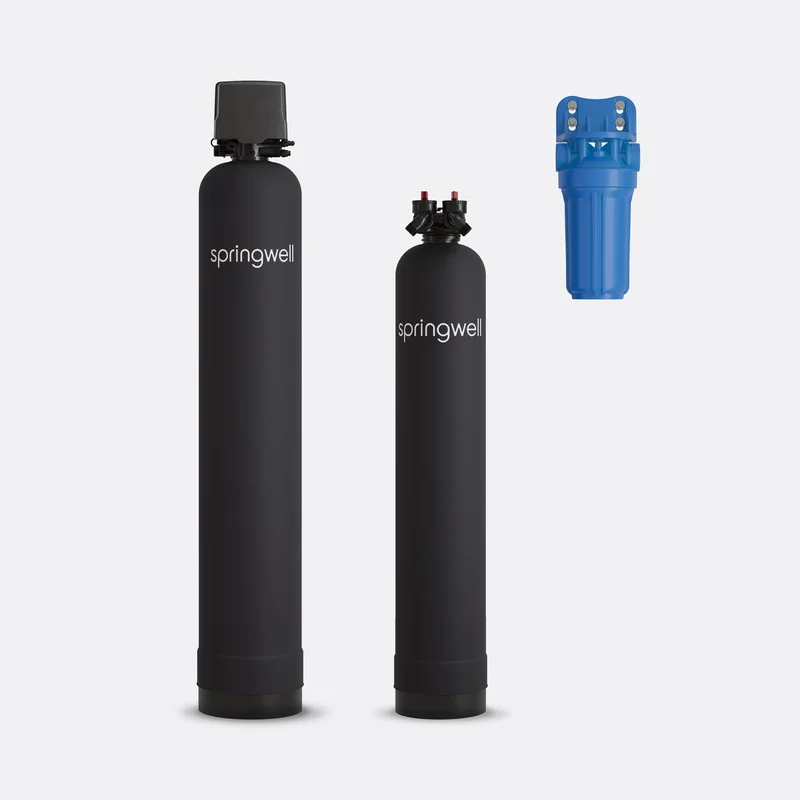
SpringWell · Combination system · $3,213 (sale) at SpringWell as of Oct 2026
WS1 iron filter plus FS1 salt-free conditioner in one order, both 12 GPM, with lifetime warranty and a $567 saving over separate list prices. Conditioner limits scale but leaves hardness in the water.
Every figure on this site is linked to the EPA, CDC, USGS, a state health department, a university extension office or a dated manufacturer page.
The installer directory lists independent well water treatment contractors we verified against their own websites, organized by state and city, with the services each one offers and a direct link. Backwashing tanks, drains, chemical feeds and anything a permit covers are their jobs, not a weekend project. Start with your state:
There is no single best system, because a well can have sediment, iron, sulfur, hardness, bacteria, nitrate or PFAS in any combination and each needs a different treatment. The best system for your house is the set of stages that matches your lab report, in the order sediment, iron, softener, UV, with nitrate or PFAS handled at the kitchen tap. Our best-of page ranks systems by the problem they solve.
Yes. The EPA and CDC recommend testing a private well every year for coliform bacteria, nitrate, total dissolved solids and pH, and treatment is chosen and sized from iron, manganese, hardness and pH numbers that only a test provides. Buying a filter without a test is a guess, and the wrong tank is expensive.
Sediment filter first, then an iron, manganese or sulfur filter, then a water softener, then carbon if needed, with UV disinfection last on clear, softened water. Each stage protects the next: grit clogs media, oxidized iron fouls softener resin, and UV cannot disinfect cloudy or scaled water. Reverse osmosis for nitrate or PFAS goes at the kitchen tap.
It can be, but only a test tells you. Private wells are not regulated or treated by any utility, so the owner is responsible. Bacteria, nitrate, arsenic and PFAS have no taste or smell, which is why the annual test matters more than how the water looks. If the test is clean, you may not need any treatment at all.
No. A sediment filter, iron filter, softener and UV unit together handle the common well problems, but none of them removes nitrate or PFAS, which need a reverse osmosis or certified carbon unit, usually at the kitchen tap. Every system is designed to reduce specific contaminants, and treated water should be retested to confirm it is working.