This page contains affiliate links. If you buy through them we may earn a commission at no extra cost to you. How we make money
Nitrates in Well Water: The 10 mg/L Limit, How to Test, and the Only Three Treatments That Remove It
Invisible and tasteless; a health risk for infants and pregnant women above 10 mg/L. Common near farmland and septic systems.
Nitrate is the well-water problem you find out about from a lab sheet, not a faucet. It has no color, taste or smell. If your report says nitrate-nitrogen is at or above 10 mg/L, do not use the water for infant formula or for anyone who is pregnant, and put a reverse osmosis unit, a nitrate-selective ion exchange tank or a distiller on the drinking tap. Nothing you already own, including the water heater, a carbon filter or a softener, takes nitrates in well water out.
In practice it is a farm-country and septic-country problem: a well surrounded by row crops, downslope from a feedlot or manure storage, or in a subdivision of septic systems on sandy soil. Depth matters. The USGS notes that nitrogen contamination is more of a problem in shallow aquifers, and the CDC's ATSDR profile says relatively high nitrate is found in some privately owned wells with shallow depths and permeable soils. A shallow well, or one with a failed casing, pulls in the recent recharge that carries the fertilizer.
The difference is what you do about it. A positive coliform result means fixing the well, shock chlorinating and retesting, covered on our bacteria page. High nitrate cannot be shocked away. If both come back high in a shallow well, the long-term fix is often a deeper or better-sealed well, and the short-term fix is treating the drinking tap.
Is it a health risk?
Yes, for a specific group. The EPA's enforceable Maximum Contaminant Level is 10 mg/L for nitrate measured as nitrogen and 1 mg/L for nitrite as nitrogen. The EPA's stated health effect: infants below the age of six months who drink water containing nitrate in excess of the MCL could become seriously ill and, if untreated, may die, with symptoms including shortness of breath and blue-baby syndrome.
The CDC's ATSDR public health statement describes the mechanism: young infants under 6 months of age appeared particularly sensitive to the effects of nitrite on hemoglobin after consuming formula prepared with water containing nitrate above recommended limits, and it defines methemoglobinemia as a change to hemoglobin that decreases the ability to transport oxygen to tissues. The same document puts the EPA limit at 10 mg/L as nitrate-nitrogen, roughly 44 mg/L as nitrate. Virginia Tech goes further on who should avoid the water: do not use it for formula or infant drinking water once nitrate-N approaches 3 to 5 mg/L, and pregnant women should avoid water above 10 mg/L.
The MCL applies to public water systems; a private well is not regulated, but 10 mg/L as N is the number every state lab and health department uses. The other thing to get right is the units.
Nitrate-N vs. nitrate as NO3
Labs report nitrate two ways, and the difference is a factor of 4.4. Nitrate-nitrogen (NO3-N) counts only the nitrogen atom; nitrate (NO3) counts the whole ion. The EPA's 10 mg/L limit is as N. Penn State states it as 45 mg/L of nitrate or 10 mg/L of nitrate-nitrogen, and NC State says the same, adding that when reading lab reports you must note whether values are for nitrate-nitrogen or nitrate.
Reported as
EPA limit
A result of 20 mg/L means
Nitrate-nitrogen (NO3-N)
10 mg/L
Twice the limit
Nitrate (NO3)
45 mg/L
Under half the limit (about 4.5 mg/L as N)
How to test for nitrates
Nitrate is a certified-lab test. Strips exist, but in the 3 to 10 mg/L range where decisions get made they are not precise enough to act on.
Test before an infant or a pregnancy depends on the water. Nitrate interferes with the blood's ability to carry oxygen in infants under six months (methemoglobinemia, or blue-baby syndrome). If anyone in that group drinks the water, test now and every year after.
Order nitrate as N from a certified lab. Ask specifically for nitrate-nitrogen (NO3-N). Some labs report nitrate as NO3, which reads 4.4 times higher; the EPA limit of 10 mg/L is as N (45 mg/L as NO3).
Sample in spring and after heavy rain. Nitrate levels in shallow wells swing with the season and with fertilizer application. A single low result in late summer does not clear the well.
Treat at the tap, not the house. Nitrate is a drinking-water problem; bathing in it is harmless. Point-of-use reverse osmosis or an ion-exchange unit on the kitchen tap is the normal fix. Boiling concentrates nitrate; carbon filters and softeners do not remove it.
Add nitrite, total coliform and E. coli to the same order, plus total dissolved solids and sulfate if you expect to buy treatment; those two numbers decide between RO and ion exchange. Sample from a cold tap ahead of any treatment, after flushing the line. The EPA says to test more often when small children live in the house or someone is pregnant or nursing, and the Minnesota Department of Health says to test for nitrate every year. Our well water testing guide lists what else belongs on an annual panel and how to find a certified lab.
An under-sink RO membrane rejects most nitrate and is the usual choice. Penn State reports RO removing roughly 83 to 92 percent of nitrate; Virginia Tech notes a home unit produces only 10 to 20 percent of its feed as treated water, the rest going to drain. Look for NSF/ANSI 58 certification with a nitrate/nitrite reduction claim on the listing. Removal falls as the membrane ages and when total dissolved solids are high, so retest the product water after installation and yearly. It needs a sediment prefilter, and hard water or iron should be treated upstream or the membrane scales.
Nitrate-selective ion exchange
A resin tank regenerated with salt that trades nitrate for chloride, built like a softener but with anion resin. It can be point-of-use or whole-house and handles high nitrate that RO cannot. The catch is sulfate. Standard anion resin prefers sulfate to nitrate; the University of Wisconsin's guide warns that if sulfate is moderate to high the unit's ability to remove nitrate may be reduced, making frequent monitoring a necessity, and an exhausted standard resin can dump captured nitrate back into the water. Specify nitrate-selective resin when sulfate is present. Dealer-installed and sized from the lab report.
Distillation
A countertop still boils the water and condenses the steam; nitrate stays in the boiler. It works reliably but slowly: Penn State cites about a gallon every four to five hours and an energy cost of roughly 30 cents per gallon. Practical for drinking water only, and hard water scales the boiler fast.
What does not work
Boiling. Minnesota Department of Health: do not try to boil nitrate out of the water; boiling will make nitrate more concentrated. Penn State and Virginia Tech say the same. Do not boil high-nitrate water to make formula.
Carbon filters. Activated carbon does not effectively remove nitrate, per the Wisconsin guide. A pitcher, a fridge filter or a whole-house carbon tank does nothing for it.
Water softeners. A softener swaps calcium and magnesium for sodium. It does not touch nitrate, which is an anion.
Chlorination and sediment filters. Virginia Tech is explicit that chlorination and mechanical filters will not remove nitrate. A sediment filter and a UV lamp are fine for what they do, but nitrate passes straight through both.
APEC Water Systems · Reverse osmosis · $231 at APEC Water Systems as of Oct 2026
Treats
Nitrates, PFAS
Flow
—
Capacity
—
Install
DIY
Warranty
1-year
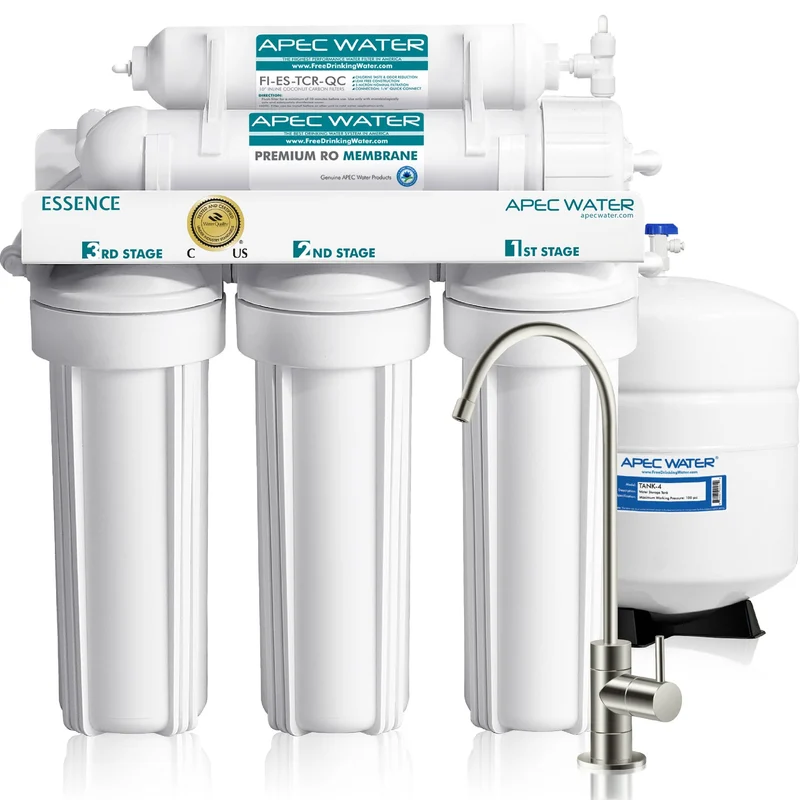
Five-stage under-sink RO rated 50 GPD, WQA Gold Seal system (NSF/ANSI 58, TDS reduction) with tank and faucet, $230.99. Nitrate and PFAS reduction are maker claims; 1-year warranty.
APEC Water Systems · Reverse osmosis · $269 at APEC Water Systems as of Oct 2026
Treats
Nitrates, PFAS
Flow
—
Capacity
—
Install
DIY
Warranty
1-year
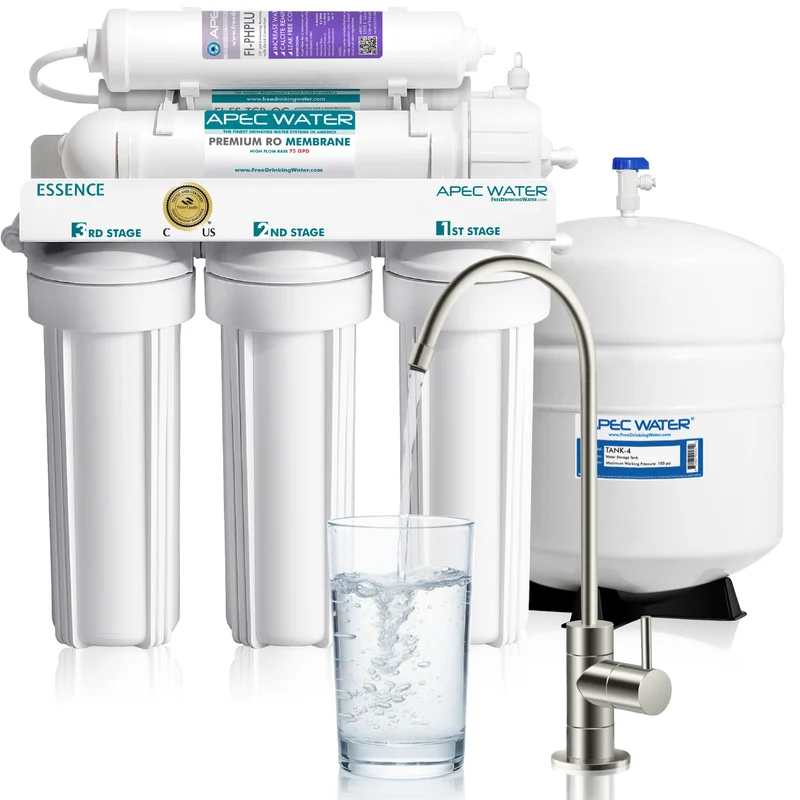
Six-stage under-sink RO rated 75 GPD with a calcite pH stage, WQA Gold Seal system (NSF/ANSI 58, TDS reduction), $268.99 with tank and faucet. Nitrate and PFAS are maker claims; 1-year warranty.
Aquasana · Reverse osmosis · $225 (sale) at Aquasana as of Oct 2026
Treats
Nitrates, PFAS
Flow
0.7 GPM
Capacity
250 gal
Install
DIY or pro
Warranty
2-year
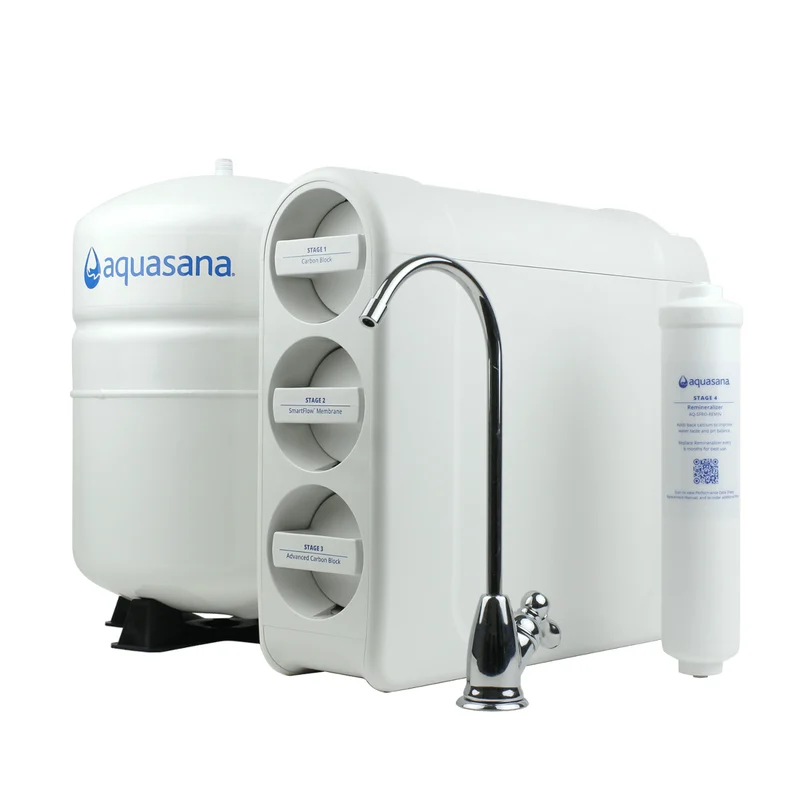
Under-sink RO certified by WQA to NSF/ANSI 42, 53, 58 and 401, including nitrate/nitrite (78%) and PFOA/PFOS. 0.7 GPM faucet flow, 25.7 GPD, $224.99 on sale. Cartridges last 250 gallons or 6 months.
For most households the decision is simple: an NSF/ANSI 58 under-sink RO with a nitrate claim, fed by a sediment prefilter, with hardness and iron handled ahead of it if they are high. Go to nitrate-selective ion exchange when the result is well over the limit, when sulfate is also high, or when you need treated water at more than one tap. Use the sizing tool to check daily drinking-water demand against an RO unit's rated output and tank size.
Before you buy
Have the lab sheet in hand with nitrate-N, nitrite, sulfate and TDS on it; every dealer and product rating starts from those numbers. Compare certified units on the best well water filters page, size the system with the sizing tool, and read how to test well water so the retest after installation is done right. An ion-exchange tank or a whole-house setup is a job for a licensed installer; an under-sink RO is a reasonable weekend project. Whatever you choose, retest the treated water within a month and every year after; only the number tells you it worked.
Frequently asked questions
What is the safe level of nitrate in well water?+
The EPA Maximum Contaminant Level is 10 mg/L for nitrate measured as nitrogen (nitrate-N), which is about 45 mg/L reported as nitrate. The limit is enforceable for public water systems, not private wells, but it is the number every state lab and health department uses. Virginia Tech's extension program advises not using water for infant formula once nitrate-N approaches 3 to 5 mg/L.
Why is nitrate dangerous for babies?+
The EPA states that infants below six months who drink water with nitrate above the limit could become seriously ill and, if untreated, may die, with symptoms including shortness of breath and blue-baby syndrome. The CDC's ATSDR profile describes methemoglobinemia as a change to hemoglobin that decreases the ability to transport oxygen to tissues, and notes that infants under 6 months fed formula made with high-nitrate water appeared particularly sensitive. Pregnant women are also advised to avoid water above 10 mg/L.
Does boiling water remove nitrate?+
No. Boiling makes it worse. The Minnesota Department of Health, Penn State and Virginia Tech all state that boiling increases the nitrate concentration because water evaporates and the nitrate stays behind. Do not boil high-nitrate well water to make infant formula.
Will my water softener or carbon filter take nitrate out?+
No. NC State Extension summarizes it: boiling, filtration, disinfection and water softening do not remove nitrate. A softener exchanges calcium and magnesium, not nitrate; activated carbon does not adsorb it; sediment filters, chlorination and UV pass it straight through. Only reverse osmosis, ion exchange and distillation remove nitrate.
What is the difference between nitrate-N and nitrate on my lab report?+
Nitrate-nitrogen counts only the nitrogen atom; nitrate (NO3) counts the whole ion, which weighs about 4.4 times more. The EPA limit of 10 mg/L is as nitrogen, equal to 45 mg/L as nitrate. A result of 20 mg/L is twice the limit if it is nitrate-N and under half the limit if it is nitrate, so confirm which one your lab reported.
Should I treat the whole house for nitrate?+
Usually not. Nitrate is a drinking and cooking problem; bathing and laundry are unaffected. An under-sink reverse osmosis unit with an NSF/ANSI 58 nitrate reduction claim is the normal fix. Whole-house nitrate-selective ion exchange makes sense when levels are far above the limit, sulfate is high, or you need treated water at several taps.
Sources
Figures and quotations above come from these pages as read on 2026-10-05. These are reference links, not affiliate links.