A whole house well water filter is not one product. It is a short chain of treatment stages, installed where the water line enters the house, each one fixing a specific problem the water test found and each one protecting the stage behind it. Most of what goes wrong with well treatment (a softener fouled with iron, a UV lamp blinded by cloudy water) is a stage in the wrong place or a stage missing.
If you have not tested yet, start at how to test well water. Everything below depends on knowing what is in the water.
Point-of-entry vs. point-of-use
The Minnesota Department of Health's home water treatment sheet draws the line simply. Point-of-use (POU) units "treat water at one faucet or one location"; point-of-entry (POE) units "are installed on the water line as it enters the home" and "treat all of the water in your home."
A whole-house system is POE: the right scale for sediment, iron and manganese stains, hardness scale, sulfur odor and bacteria, and the wrong scale for contaminants that only matter in the water you drink, which is why a POE train on a well usually ends with a POU reverse osmosis unit at the kitchen tap for nitrates, arsenic or PFAS. The CDC's guide to choosing home water filters makes the same distinction between whole-home and single-tap filters.
The well treatment train, in order
Not every well needs every stage; the water test decides. But a stage that is needed goes in this position.
1. Sediment
Sand, silt and rust come first because everything behind them clogs. Penn State's softening guide warns that turbid water can clog softener resin with mud and clay, and its coliform guide requires that water reaching a UV unit be completely clear. A spin-down screen for sand, then a 5 micron cartridge for silt, is the usual pair; a backwashing media filter replaces both on a heavy well. Details on the sediment filter guide and the sediment problem page.
2. Iron, manganese and sulfur oxidation
Penn State's iron and manganese guide says a softener can handle dissolved iron only below about 5 mg/L and only if the raw water has not touched air or chlorine, because oxidized iron "will clog the resin." Above that, or with any sulfur, an oxidizing filter goes in ahead of the softener: Penn State recommends one when combined iron and manganese are in the 3 to 10 mg/L range, and chemical oxidation (chlorine, permanganate or peroxide feed) plus filtration above 10 mg/L. See iron filter for well water, manganese and rotten egg smell.
3. Softener
Hardness (calcium and magnesium) is handled by a cation exchange softener once the iron is gone. Softening after oxidation keeps the resin clean; softening before UV keeps scale off the UV sleeve, which Penn State's coliform guide notes "may require routine cleaning or addition of a water softener." See softener for well water.
4. Carbon
Activated carbon follows the softener when there is taste, odor or an organic contaminant to deal with, and always after a chlorine feed to strip the chlorine. The Minnesota Department of Health's GAC page explains that carbon adsorbs organic chemicals and odors but that iron and nitrate "are not attracted to the carbon and are not removed," which is why it does not go earlier in the train. Penn State's hydrogen sulfide guide limits plain activated carbon to small sulfur concentrations, under about 1.0 mg/L.
5. UV disinfection
UV goes last among the POE stages because it needs clear, soft, iron-free water. UGA's disinfection bulletin lists the three enemies: turbidity shields organisms from the light, iron and manganese color the water and cut UV output, and hardness scales the quartz sleeve. Virginia Tech's household treatment guide says UV is "typically the last device in a household water treatment system." It leaves no residual, so anything introduced into the plumbing after the lamp is not treated. See UV filter for well water.
6. Reverse osmosis at the tap
RO is POU, under the kitchen sink, for the water you drink and cook with. It wastes most of what goes through it (the University of Missouri's treatment overview puts the reject at about 75 percent or more), which is why it is not a whole-house stage.
Media types and what each treats
Air injection (aeration and filtration). A venturi or compressor draws air into the top of the tank; the dissolved iron, manganese or sulfide oxidizes on contact and the solid is caught in the media bed below, then backwashed to drain. The Minnesota Department of Health lists aeration and filtration as treating hydrogen sulfide, iron, manganese and other dissolved gases without added chemicals, and notes that over-oxygenated water can be corrosive to copper or lead plumbing. Penn State's sulfur guide says aeration is normally not used above about 2 mg/L hydrogen sulfide.
Manganese greensand. A natural mineral coated with manganese oxide that both catalyzes oxidation and filters the result. UGA's oxidizing filter bulletin describes it, including the periodic regeneration with potassium permanganate and the warning that hydrogen sulfide consumes the coating quickly. Penn State's guides put greensand at up to 2 to 3 mg/L of sulfide and in the 3 to 10 mg/L range for combined iron and manganese. Other manganese-dioxide media (coated pumice, or solid manganese dioxide) work on the same principle; Penn State notes the coated pumice type needs pH of at least 6.8 for iron and 7.5 for manganese.
Catalytic carbon. A modified activated carbon marketed for hydrogen sulfide and chloramine as well as taste and odor. Verify any catalytic-specific claim on the manufacturer's certification listing rather than the box.
Flow rate and pressure drop: sizing the system
A whole-house system has to pass your peak flow without starving the fixtures, and every tank in the train takes a few psi. Three numbers set the size.
Peak household flow. Penn State's water system planning guide suggests a minimum of 6 GPM from the well for most single-family homes and lists 10 GPM for a three-bedroom, two-bath house. Count bathrooms and the fixtures that run at the same time.
Pump output. The system cannot deliver more than the well and pump do, and a train rated below the pump is a restriction.
Backwash flow. An oxidizing or sediment media tank has to lift and rinse its bed, and UGA's oxidizing filter bulletin says that usually takes "more than double the normal service flow rate." A well that delivers 6 GPM may not be able to backwash a tank sized for a 12 GPM house. Smaller-diameter tanks, or a cartridge stage instead of a tank, are the workarounds.
The sizing tool turns bathroom count and pump output into a service flow target and a stage order.
Tank vs. cartridge systems
Tank (backwashing) systems hold a bed of media and clean themselves on a timer by backwashing to drain. They handle heavy, continuous loads and the media lasts years. They need a drain able to take the backwash flow, an outlet for the valve, a well that can supply the backwash rate, and floor space. Oxidizing filters and softeners are almost always tanks.
Cartridge systems are housings with replaceable elements in the 4.5 in. sizes. They need no drain or power and are cheap to install. They cost more per year in cartridges, have a hard ceiling on how much they can hold, and are a poor match for heavy iron or sulfur. Virginia Tech's guide describes cartridge maintenance as simply "periodically changing filter cartridges," and that is both the appeal and the limit.
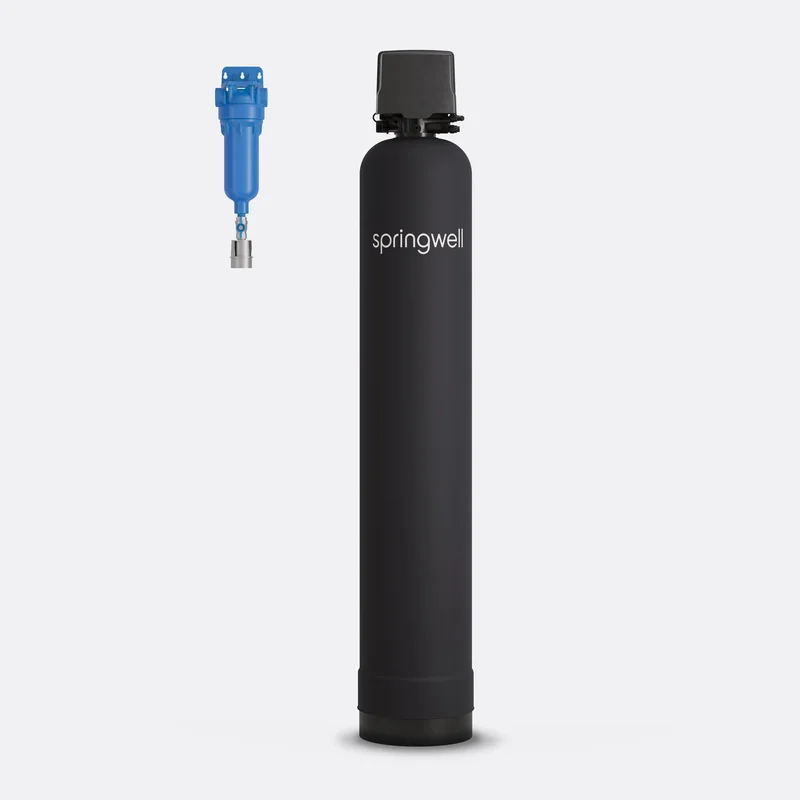 #1
#1SpringWell · Iron filter · $2,231 (sale) at SpringWell as of Oct 2026
- Treats
- Iron, Manganese, Sulfur
- Flow
- 12 GPM
- Capacity
- —
- Install
- DIY
- Warranty
- Lifetime
Single-tank air-injection filter rated for iron to 7 ppm, hydrogen sulfide to 8 ppm and manganese to 1 ppm at 12 GPM, with a lifetime tank and media warranty. No NSF certification; needs a drain and power.
 #2
#2US Water Systems · Iron filter · $2,983 (sale) at US Water Systems as of Oct 2026
- Treats
- Iron, Manganese, Sulfur
- Flow
- 10 GPM
- Capacity
- —
- Install
- DIY or pro
- Warranty
- 10-year
Peroxide-injection and catalytic carbon system rated for iron to 20 ppm, hydrogen sulfide to 30 ppm and pH 6-9 at 10 GPM, with a lifetime tank warranty. Needs peroxide refills; no system-level certification.
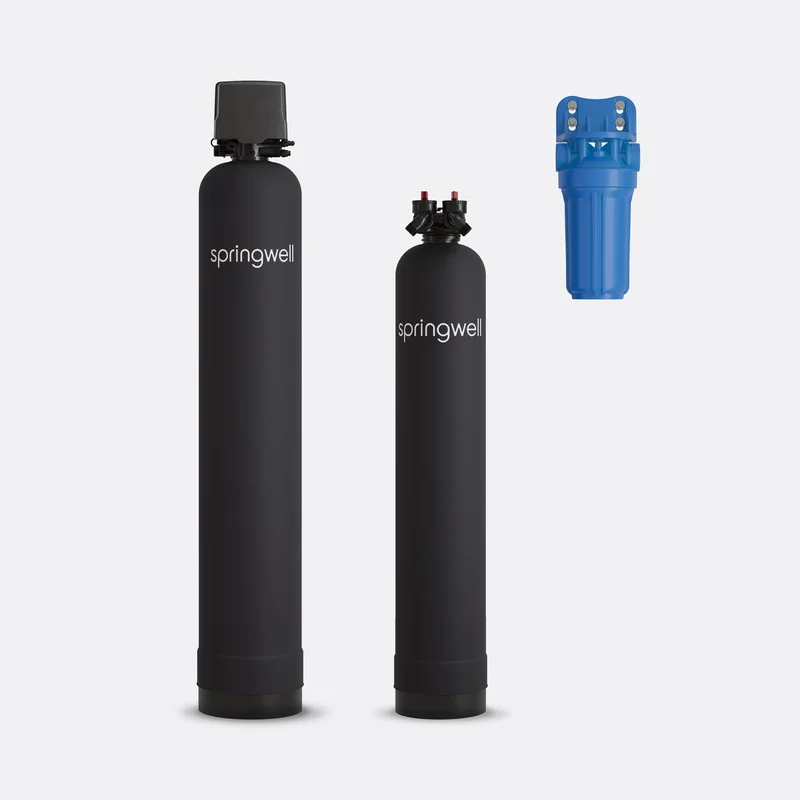 #3
#3SpringWell · Combination system · $3,213 (sale) at SpringWell as of Oct 2026
- Treats
- Iron, Manganese, Sulfur, Hardness
- Flow
- 12 GPM
- Capacity
- —
- Install
- DIY
- Warranty
- Lifetime
WS1 iron filter plus FS1 salt-free conditioner in one order, both 12 GPM, with lifetime warranty and a $567 saving over separate list prices. Conditioner limits scale but leaves hardness in the water.
These are the current top-ranked whole-house systems from our data; the best well water filters page explains the ranking and lists the rest.
Maintenance and consumables
Nothing in a treatment train is install-and-forget. The Minnesota Department of Health lists the routine (changing filters, disinfecting the unit, backwashing, cleaning out scale) and warns that unmaintained units lose effectiveness and "can make water quality worse and make you sick." By stage:
- Spin-down: flush weekly to monthly; scrub the screen twice a year.
- Sediment cartridge: change on pressure drop or at three to six months; see sediment filter replacement.
- Oxidizing tank: confirm the backwash runs; regenerate greensand with permanganate on schedule; replace media when it stops holding.
- Softener: keep salt in the brine tank; clean it yearly; check for resin fouling if iron gets through.
- Carbon: replace the cartridge or tank media on the maker's schedule; UGA's overview notes that bacteria can grow in a spent filter.
- UV: replace the lamp about once a year (Penn State's coliform guide, and UGA's bulletin, which cites 9,000 hours); clean the quartz sleeve; replace it if etched.
- RO: prefilters and postfilter on schedule, membrane every few years.
Then retest. The Minnesota sheet's last step is to test the treated water after installation to confirm it is working, and to keep testing on the schedule in how to test well water.
Certifications to look for, explained plainly
Residential treatment equipment is not federally regulated; what exists is a set of voluntary NSF/ANSI standards and three accredited bodies that test to them. NSF's overview of the standards is the reference for the first group.
- NSF/ANSI 42 (aesthetic effects). Chlorine, taste and odor, particulate, and (per NSF's filtration standards page) iron, manganese, zinc and TDS. A sediment cartridge with a particulate claim is certified here.
- NSF/ANSI 44 (softeners). Cation exchange softeners regenerated with sodium or potassium chloride; covers hardness reduction, capacity and brine accuracy.
- NSF/ANSI 53 (health effects). Contaminants with a health effect: lead, cysts such as Cryptosporidium, VOCs and more than fifty others. Each claim is separate; "NSF 53" alone does not say which.
- NSF/ANSI 55 (UV). Class A systems are designed to inactivate bacteria, viruses and cysts in contaminated water; Class B only reduces non-disease-causing bacteria in water already safe. For a well that failed a bacteria test, Class A is the one that matters.
- NSF/ANSI 61 (drinking water system components). Not a performance standard. NSF's standard 61 page says it sets health-effects requirements for chemicals that leach from products that touch the water and "does not establish performance" requirements.
- NSF/ANSI/CAN 372 (lead content). Also not a performance standard. Per NSF's 372 page, it caps weighted lead content at 0.25 percent for wetted components and 0.2 percent for solders and fluxes.
The certifying bodies: NSF itself; the Water Quality Association, whose Gold Seal program certifies to the same NSF/ANSI standards; and IAPMO R&T, whose water systems program lists to NSF/ANSI 42, 44, 53, 55, 58, 61, 372 and others. "Tested to NSF standards" without a listing is marketing; Penn State's buying guide says to look for NSF and WQA certification specifically and to confirm any in-home sales test with an independent lab before buying.
When to call a pro
A sediment housing and a UV chamber are honest DIY jobs. These are not:
- Iron above a few mg/L, any sulfur, or iron plus manganese together. Media selection, pH correction and backwash sizing interact.
- Chemical feed systems (chlorine, peroxide, permanganate), where the dose has to be set against your water.
- A well that cannot backwash. The fix may be a different tank size, a cistern, or a well repair.
- Arsenic, radium, uranium or PFAS on the test. Minnesota's sheet says to work with a professional on arsenic because pre-oxidation may be needed.
Virginia Tech's guide says to have the water analyzed by a certified lab "and to consult a professional before purchasing any water treatment equipment," and UGA's overview recommends a second opinion on any recommended system. Get the lab report, run the sizing tool, read the ranked systems on the best well water filters page, and then talk to a well water installer near you.