Black crust around the toilet waterline, dark flakes in the dishwasher, laundry with brown-black marks that iron tests do not explain. Manganese in well water is iron's quieter cousin: it stains at one sixth the concentration, it is harder to oxidize, and unlike iron it carries a health advisory that matters if a baby drinks the water. The short answer: test with a certified lab, compare the result to both the 0.05 mg/L staining level and the 0.3 mg/L health advisory, and treat it with a catalytic oxidizing filter or, at low levels, a softener.
What causes manganese in well water
Manganese is a natural mineral in bedrock and in the glacial sediments that cover much of the northern US. The USGS groundwater quality page explains that groundwater dissolves metals such as iron and manganese as it moves through sediments. Low-oxygen groundwater keeps it dissolved, which is why it reaches your tap clear and shows up later as black deposits.
Geography matters more than with most contaminants. The USGS national manganese assessment found elevated manganese concentrated along the Mississippi River valley, the Atlantic coast up to Maine and the Great Lakes region, most often near rivers, where the water table is shallow or where soils are rich in organic carbon. In the glacial aquifer system of the northern states, a USGS study of 1,590 wells found manganese exceeded its health benchmark more often than any other element, with 9.9 percent of drinking-water wells over the lifetime health advisory. Minnesota's health department reports southwestern Minnesota groundwater over 1,000 µg/L (1 mg/L). If your neighbors have black stains, assume you do too.
How to tell manganese from iron, tannins and sulfur
Manganese almost always travels with iron, so the question is usually which one is causing the stain you are looking at.
| Symptom | Most likely | Page |
|---|
| Black, brown-black or purple-black stains; black flakes in the toilet tank | Manganese | This page |
| Orange, red or rust stains; water turns orange on standing | Iron | Oxidizing filter |
| Black stains plus a rotten-egg smell; tarnished silverware | Hydrogen sulfide | Air-injection or carbon |
| Even yellow to tea color that never settles | Tannins | Anion resin |
| Grit or sand that settles in a jar | Sediment | Spin-down or cartridge |
Virginia Tech's iron and manganese publication describes dissolved manganese as clear at the tap, forming black particles after standing, while the oxidized form colors tap water brownish-black immediately. Manganese bacteria leave a black-brown slime rather than a hard deposit. The Water Quality Association's manganese fact sheet is direct: black stains on the shower, toilet, fixtures or laundry make manganese likely, and the next step is a certified lab test.
Is it a health risk?
Yes, at a level that is not far above the staining level, and especially for infants. Be precise about which number you are reading.
- Secondary standard (aesthetic): 0.05 mg/L. The EPA's secondary drinking water standards set this non-enforceable guideline for black to brown color, black staining and bitter metallic taste. It is not a health limit.
- Lifetime health advisory: 0.3 mg/L. The EPA's 2004 Drinking Water Health Advisory for Manganese sets a lifetime advisory of 0.3 mg/L to protect against potential neurological effects, and a one-day and ten-day advisory of 1 mg/L for short-term exposure. It then advises that for infants younger than six months, the 0.3 mg/L lifetime value be used even for a ten-day exposure, because young infants absorb more manganese and excrete less of it. A health advisory is guidance, not an enforceable MCL; there is no federal MCL for manganese.
- State guidance can be stricter. The Minnesota Department of Health's manganese guidance sets 100 µg/L (0.1 mg/L) as the safe level when an infant drinks tap water or formula made with it, and 300 µg/L (0.3 mg/L) for everyone over one year old. MDH links long-term exposure to problems with memory, attention and motor skills, and to learning and behavior problems in infants. Its advice for new parents is to test a private well for manganese at least once before or during pregnancy.
Bathing is not the concern; MDH and WQA both note that exposure comes from drinking the water. Nationally, the USGS estimates that about 7 percent of domestic wells exceed the 300 µg/L benchmark, serving roughly 2.6 million people.
How to test for manganese in well water
Because the health advisory sits so close to the staining level, this is a lab test, not a kit test.
- Order a certified lab test. Manganese has a health advisory level, so use a state-certified lab and ask for manganese, iron, pH and hardness. Home strips are not reliable at the 0.05 mg/L level where staining begins.
- Sample before any treatment. Collect from a tap ahead of a softener or filter, after flushing the line for several minutes, following the lab's bottle and holding-time instructions.
- Compare to both limits. The secondary (aesthetic) standard is 0.05 mg/L; staining starts there. The EPA lifetime health advisory is 0.3 mg/L. EPA's short-term (1-day and 10-day) advisory is 1 mg/L, but for infants under six months EPA advises using the 0.3 mg/L value even for short exposures, so formula should not be mixed with water above 0.3 mg/L. Above 0.3 mg/L, treat it as a health problem, not a laundry problem.
- Retest after installing treatment. Manganese is harder to oxidize than iron; simple oxidizing media need a pH of roughly 7.5 or higher (Penn State Extension), and lower-pH water usually needs a catalytic media or a chemical feed. Confirm removal with a follow-up lab test on treated water.
Labs report manganese in either mg/L or µg/L; 0.05 mg/L is 50 µg/L and 0.3 mg/L is 300 µg/L. The EPA recommends annual well testing through a certified laboratory; the testing guide covers the process.
Treatment options
Manganese removal follows the iron playbook with one difference: it oxidizes slowly in plain air at the pH of most well water. North Dakota State University's removal guide puts the optimal pH for chlorine oxidation at 8.0 for iron but 8.5 for manganese, and Penn State Extension's iron and manganese guide says one common oxidizing media needs a minimum pH of 6.8 for iron but 7.5 for manganese. That is why a basic iron filter can leave manganese behind. Put a sediment filter ahead of any of these.
Air-injection oxidizing filter with catalytic media
The same single-tank air-injection design used for iron, but with a manganese-dioxide coated catalytic media instead of plain sand. The catalytic surface oxidizes manganese at a lower pH than air alone can manage, and the backwash cycle flushes the black oxide to drain. Most iron filters marketed for well water publish a separate manganese rating; check it against your lab number, not the iron rating. These units need a drain, a backwash flow your pump can deliver (see the sizing tool) and pH in the media's range; acidic water needs a neutralizer ahead of it.
Greensand filter with chemical feed
Manganese greensand regenerated with potassium permanganate, or a catalytic media with a continuous chlorine feed, removes manganese reliably at high levels or in low-pH water. Penn State recommends greensand-type oxidizing filters for 3 to 10 mg/L of combined iron and manganese and chemical oxidation followed by filtration above 10 mg/L; Virginia Tech's table extends oxidizing filters to 15 mg/L combined. The chemical feed and the regeneration schedule make this a dealer-installed and dealer-maintained system, with a carbon filter downstream to remove any residual chlorine.
Water softener (low levels only)
Ion exchange resin removes dissolved manganese along with hardness, provided the water has no oxygen and the level is low. Penn State lists softening for combined iron and manganese under 5 mg/L at pH above 6.7, and a 2016 Minnesota study cited by MDH found softeners an effective way to reduce manganese in drinking water. WQA notes that product certification for reducing manganese to 0.05 mg/L exists for cation exchange, filtration, distillation and reverse osmosis. The catch: oxidized manganese fouls resin just as rust does, so a softener only works on water that is still clear at the tap, with a sediment filter ahead of it.
Point-of-use reverse osmosis for drinking water
If a baby is drinking the water now and the whole-house system is months away, an under-sink RO unit at the kitchen tap covers the drinking and formula water first. WQA lists reverse osmosis among the certified manganese reduction technologies. It does nothing for stains elsewhere in the house.
Systems that treat manganese in well water
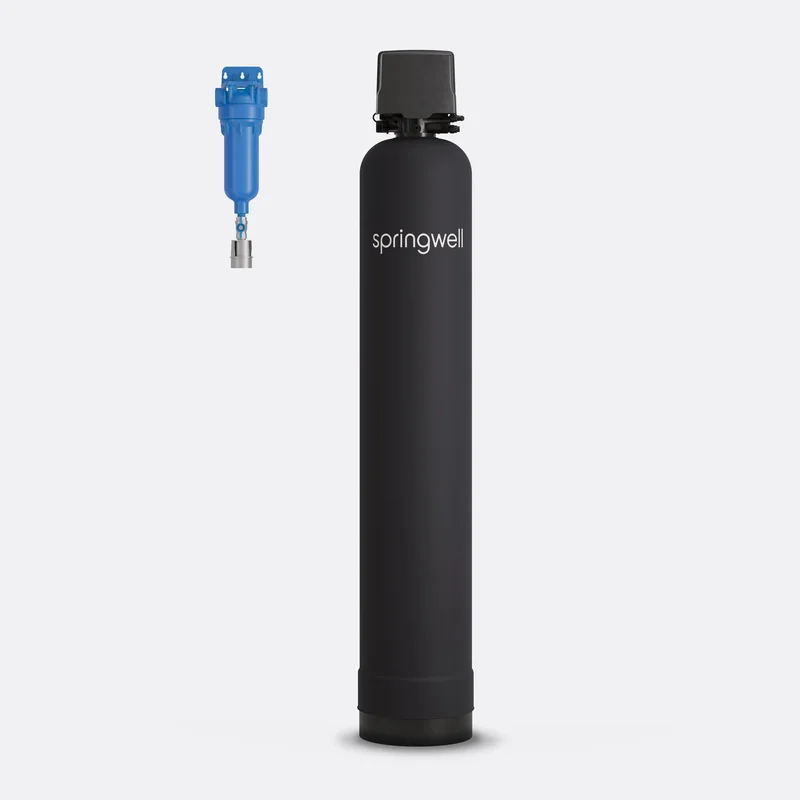
SpringWell · Iron filter · $2,231 (sale) at SpringWell as of Oct 2026
- Treats
- Iron, Manganese, Sulfur
- Flow
- 12 GPM
- Capacity
- —
- Install
- DIY
- Warranty
- Lifetime
Single-tank air-injection filter rated for iron to 7 ppm, hydrogen sulfide to 8 ppm and manganese to 1 ppm at 12 GPM, with a lifetime tank and media warranty. No NSF certification; needs a drain and power.
US Water Systems · Iron filter · $2,983 (sale) at US Water Systems as of Oct 2026
- Treats
- Iron, Manganese, Sulfur
- Flow
- 10 GPM
- Capacity
- —
- Install
- DIY or pro
- Warranty
- 10-year
Peroxide-injection and catalytic carbon system rated for iron to 20 ppm, hydrogen sulfide to 30 ppm and pH 6-9 at 10 GPM, with a lifetime tank warranty. Needs peroxide refills; no system-level certification.
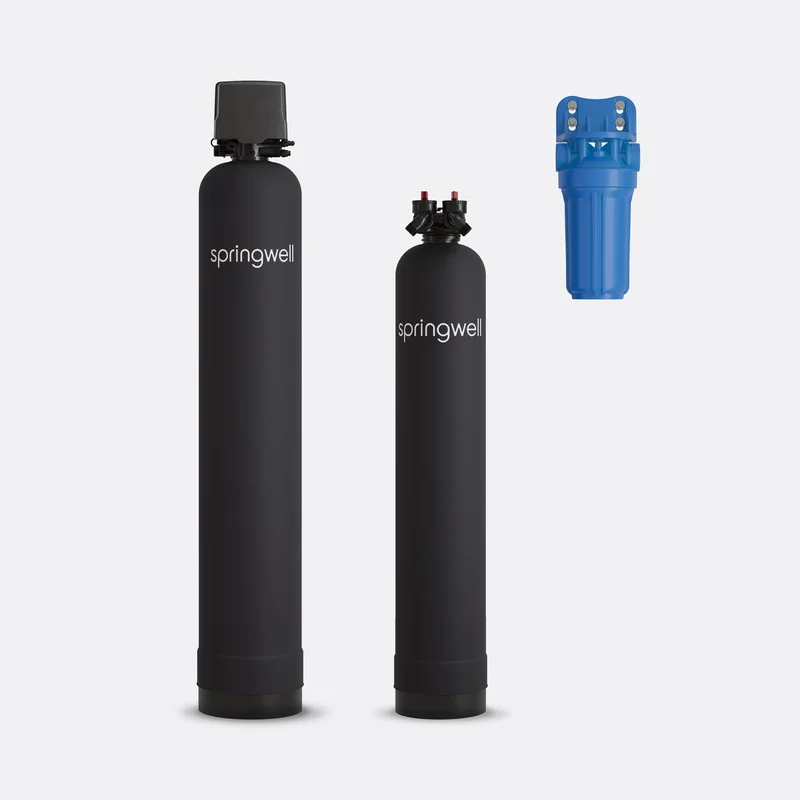
SpringWell · Combination system · $3,213 (sale) at SpringWell as of Oct 2026
- Treats
- Iron, Manganese, Sulfur, Hardness
- Flow
- 12 GPM
- Capacity
- —
- Install
- DIY
- Warranty
- Lifetime
WS1 iron filter plus FS1 salt-free conditioner in one order, both 12 GPM, with lifetime warranty and a $567 saving over separate list prices. Conditioner limits scale but leaves hardness in the water.
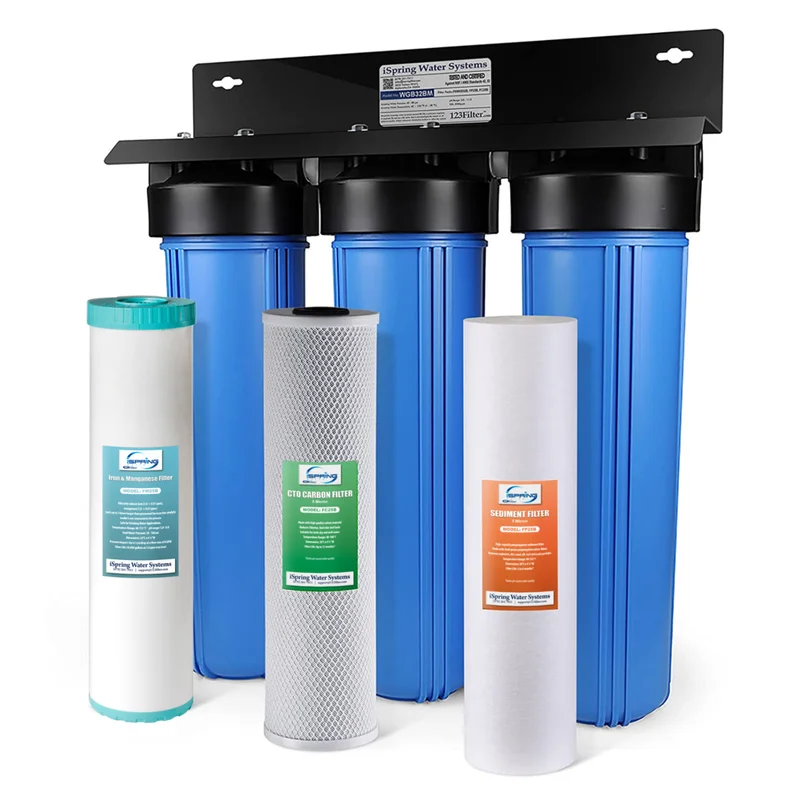
iSpring · Iron filter · $536 at iSpring as of Oct 2026
- Treats
- Iron, Manganese, Sediment
- Flow
- 15 GPM
- Capacity
- 50,000 gal
- Install
- DIY
- Warranty
- 1-year
Three-stage cartridge system with an FM25B cartridge rated for iron to 3 ppm and manganese to 1 ppm, 15 GPM, no drain or power, for $535.99. Iron cartridge lasts 50,000 gallons; no sulfur claim; 1-year warranty.
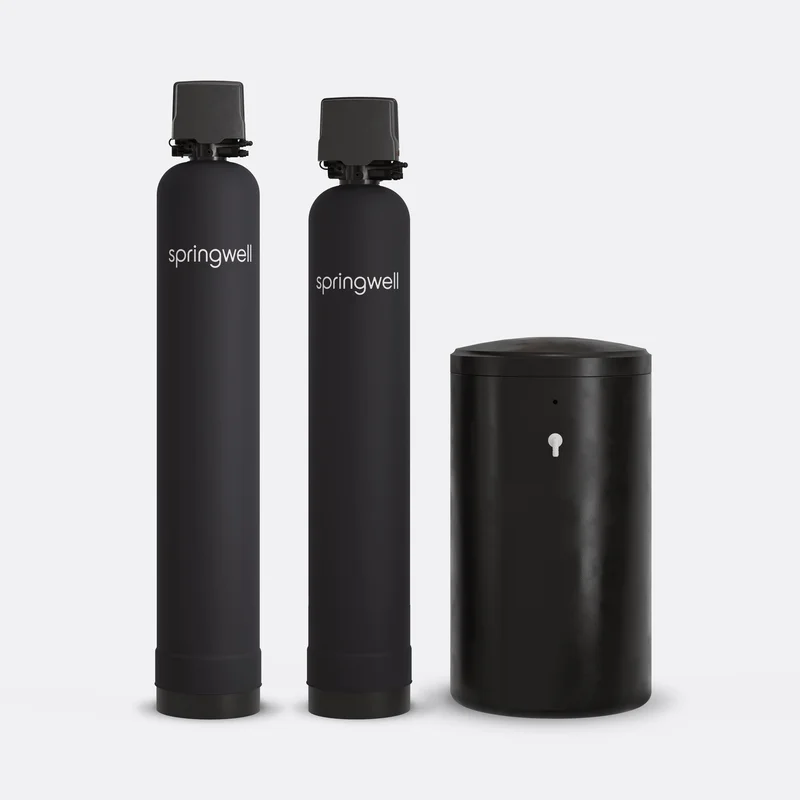
SpringWell · Combination system · $3,124 (sale) at SpringWell as of Oct 2026
- Treats
- Iron, Manganese, Sulfur, Hardness
- Flow
- 11 GPM
- Capacity
- 32,000 gr
- Install
- DIY
- Warranty
- Lifetime
WS1 iron filter plus SS1 32,000-grain softener with Bluetooth heads and a lifetime warranty, $680 less than buying separately. Two drains, two outlets and salt; service flow limited to 11 GPM.
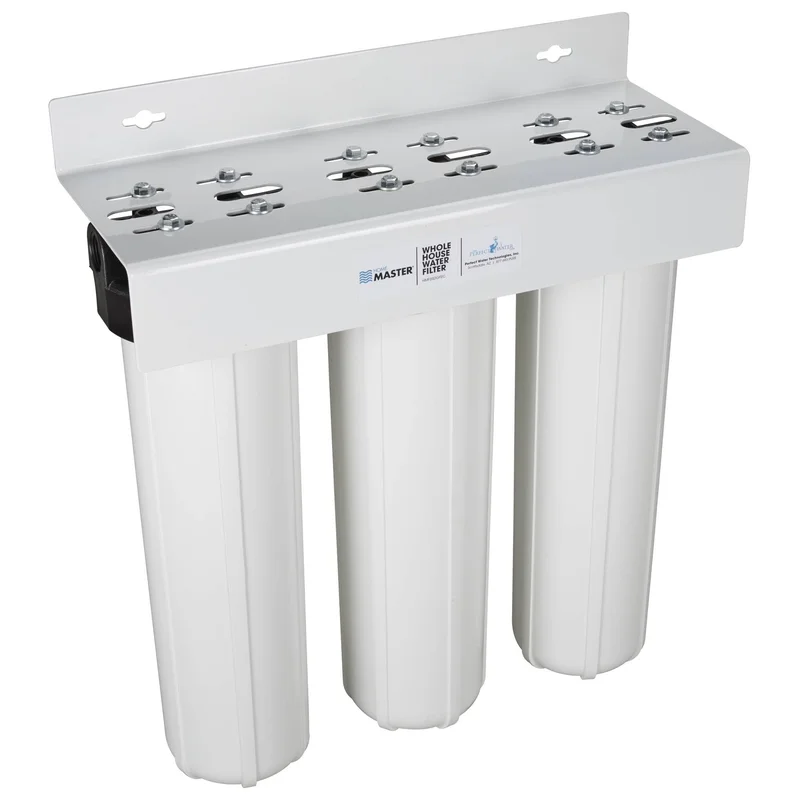
Home Master · Whole-house filter · $550 at Home Master as of Oct 2026
- Treats
- Sediment, Iron, Manganese
- Flow
- 15 GPM
- Capacity
- 100k gal
- Install
- DIY
- Warranty
- 2-year
Three-stage 20 in. cartridge system for well water with a 25-to-1 micron sediment stage, iron cartridge for iron under 3 ppm and 100,000-gallon carbon, 15 GPM, $550. No drain or power; 2-year warranty; not for pH below 7.
Pick by the manganese number, the pH and whether iron is present. At low levels with clear water at the tap and hardness to remove, a softener may handle it. Otherwise choose an air-injection unit with a catalytic media and a published manganese rating above your result. Low pH or levels above 10 mg/L combined with iron call for a dealer-installed chemical feed system. Run your flow rate and lab results through the sizing tool before you order a tank.
Before you buy
- Get a certified lab result for manganese, iron, pH and hardness through the testing guide. Strips will not resolve 0.05 mg/L.
- If anyone under one year old drinks the water, compare the result to the stricter 0.1 mg/L state guidance, not just the EPA 0.3 mg/L advisory, and use another water source for formula until treated water retests clean.
- Check the filter's manganese rating and pH range separately from its iron rating, and size the backwash to your pump with the sizing tool.
- Compare ranked systems on the best well water filters page, or find a local pro in the installer directory if a chemical feed is in your future.
- Retest treated water after installation. The lab report is the only way to know the level is below 0.05 mg/L.