White crust on the faucets, spots on the glasses, shampoo that will not lather and a water heater that died at eight years: that is hard well water, and the fix is a correctly sized ion-exchange softener. Nothing about hardness is a health problem. It is a money problem, and of all the common well water complaints it is the most expensive one to ignore, because scale shortens the life of every appliance that heats water.
If you are shopping for a softener for well water rather than city water, the iron section below is the part most sales pages skip.
What causes hard well water
The USGS defines hardness simply as the amount of dissolved calcium and magnesium in the water. Groundwater picks those up by moving through limestone, dolomite and gypsum, so wells drilled into carbonate rock are hard almost by definition. USGS mapping found hard groundwater prevalent in the east-central and western United States, following the carbonate aquifers. Well water in a given county is usually harder than the surface water nearby, because it has spent years in contact with rock.
Hardness is reported two ways. Labs and the USGS use milligrams per liter as calcium carbonate (mg/L as CaCO3); softener makers and test strips use grains per gallon (gpg). Virginia Cooperative Extension gives the conversion: 1 gpg equals 17.1 mg/L.
How to tell hardness from iron, manganese and TDS
Hardness is easy to confuse with its neighbors because they produce overlapping symptoms.
| Symptom | Hardness | Iron or manganese | High TDS |
|---|
| White or chalky crust on fixtures and in kettles | Yes | No | Sometimes |
| Orange, brown or black stains | No | Yes | No |
| Spots on dishes that wipe off | Yes | No | Yes |
| Soap will not lather | Yes | Slightly | No |
| Salty or flat taste | No | Metallic | Yes |
White scale that dissolves in vinegar is calcium carbonate: hardness. Colored stains are iron or manganese, which often ride along with hardness in the same well. Total dissolved solids (TDS) is everything in solution together, and the EPA secondary standard for TDS is 500 mg/L, with hardness and deposits listed among its noticeable effects. A softener does not lower TDS; it swaps calcium and magnesium for sodium, ion for ion.
Is it a health risk?
No. There is no EPA primary or secondary standard for hardness, and the USGS cites the World Health Organization's view that drinking water may be a useful contributor of calcium and magnesium in the diet. The relevant EPA secondary standard is the 500 mg/L TDS guideline above, and secondary standards are non-enforceable aesthetic guidelines, not health limits.
The costs are practical. USGS notes that soap reacts with calcium to form soap scum, and that deposits from heated hard water reduce the life of equipment, raise the cost of heating water, lower the efficiency of electric water heaters and clog pipes. Virginia Tech suggests that water under 7.0 gpg (120 mg/L) does not require treatment unless it is causing problems, which is a sensible line.
Softening adds sodium. Penn State Extension puts it at roughly 7.5 mg per quart for each gpg of hardness removed. Anyone on a sodium-restricted diet can run an unsoftened cold line to the kitchen tap or regenerate with potassium chloride instead.
How to test for hard well water
Hardness is one of the few things a home kit measures well, and the result is what you size the softener from.
- Use a hardness test strip or titration kit. Hardness is one of the few parameters a home kit measures accurately. Strips read in grains per gallon (gpg) or mg/L; a titration drop kit is more precise. 1 gpg equals 17.1 mg/L as calcium carbonate.
- Classify the result. USGS classes: 0 to 60 mg/L (0 to 3.5 gpg) soft, 61 to 120 mg/L (3.5 to 7 gpg) moderately hard, 121 to 180 mg/L (7 to 10.5 gpg) hard, over 180 mg/L (10.5 gpg) very hard. Scale and soap problems usually start in the hard range.
- Test iron and manganese too. Softeners are sized on compensated hardness: add about 3 to 5 gpg for every 1 mg/L of iron. If iron is above 2 to 3 mg/L, plan an iron filter ahead of the softener.
- Size the softener. Daily grain load equals gpg × people × about 75 gallons per person per day. Pick a softener whose capacity covers roughly a week of that load at its efficient salt setting; a very large softener that regenerates rarely is no better than a right-sized one.
If you are sending a sample to a certified lab anyway (see our testing guide), ask for total hardness as CaCO3 along with iron and manganese. Penn State's worked example at 10 gpg and four people comes to 3,000 grains a day, so a 20,000-grain unit regenerates every six to seven days; our sizing tool does the arithmetic. The gpg figures in the USGS classes are the mg/L ranges divided by 17.1 and rounded; many wells in carbonate country test well past the top of that scale.
Compensated hardness: the iron rule
Dissolved (ferrous) iron takes up resin sites exactly as calcium does, so a softener on well water has less capacity than its grain rating suggests. Dealers correct for this with a "compensated hardness" figure, and the common rule of thumb is to add about 3 to 5 gpg to the measured hardness for every 1 mg/L of iron, then program the softener to that number. The Water Quality Association defines compensated hardness as a calculated value that corrects for the reduction in capacity caused by iron, manganese and sodium, and notes that no single method of calculation has been uniformly accurate, which is why the rule is a range.
Where to stop using a softener for iron is clearer. Penn State's iron and manganese guidance recommends softeners only when pH is above 6.7, hardness is between 3 and 20 gpg and dissolved iron is below 5 mg/L; the WQA's softener best practices warn that hardness leakage can occur with iron above 2 ppm or hardness above 30 gpg, and that efficient salt settings assume under 2 ppm of iron. Oxidized (red) iron and iron bacteria clog resin outright. Above about 2 to 3 mg/L, plan an air-injection iron filter ahead of the softener and size the softener on hardness alone.
Treatment options
Ion-exchange water softener
Resin beads loaded with sodium (or potassium) swap it for calcium and magnesium as water passes, then regenerate by rinsing with brine. Penn State describes the cycle and notes a regeneration uses about 50 gallons of water. It is the only residential treatment that actually removes hardness. Look for NSF/ANSI 44, the standard the NSF applies to cation-exchange softeners regenerated with sodium or potassium chloride; its technical requirements cover softening capacity, rinse effectiveness, brine-system accuracy and the accuracy of the maker's own claims.
What matters on a well: demand-initiated (metered) regeneration rather than a time clock, a resin bed sized for a week of your grain load, and a sediment filter upstream. The University of Minnesota Water Resources Center reports that demand-initiated units use 26 to 60 percent less salt and 25 to 40 percent less water than time-clock units, and that 10 percent cross-linked resin can extend softener life by 50 to 100 percent, which matters when iron is present. Consumables are salt and, eventually, resin.
A softener does not fix sulfur odor, does not remove bacteria and should sit upstream of any UV unit. If the well has both, the order is sediment, iron filter, softener, UV.
Salt-free conditioner (TAC)
Template-assisted crystallization media nucleates dissolved calcium and magnesium into microscopic crystals that tend to stay suspended rather than plating onto hot surfaces. The honest description is in the WQA glossary's definition of a physical water treatment device: it may reduce or prevent certain scale deposits, but it does not provide a reduction of total calcium or magnesium content of the treated stream. Virginia Tech says the same of magnetic and electronic devices, which do not alter water chemistry and have no established U.S. test protocol. The Minnesota WRC's review of alternatives (TAC, magnetic, radio wave, chelation) concludes that most are not as well proven as ion exchange.
So a conditioner does not soften the water. Soap still scums, glasses still spot, and a hardness strip reads the same after it as before it. What it can do is cut scale on heating surfaces, with no salt, drain or electricity, which makes it reasonable where brine discharge is restricted or where scale on the heater is the only complaint. It is not a choice when iron is present, because iron fouls the media, and no conditioner carries an NSF/ANSI 44 softening claim.
Systems that treat hard well water
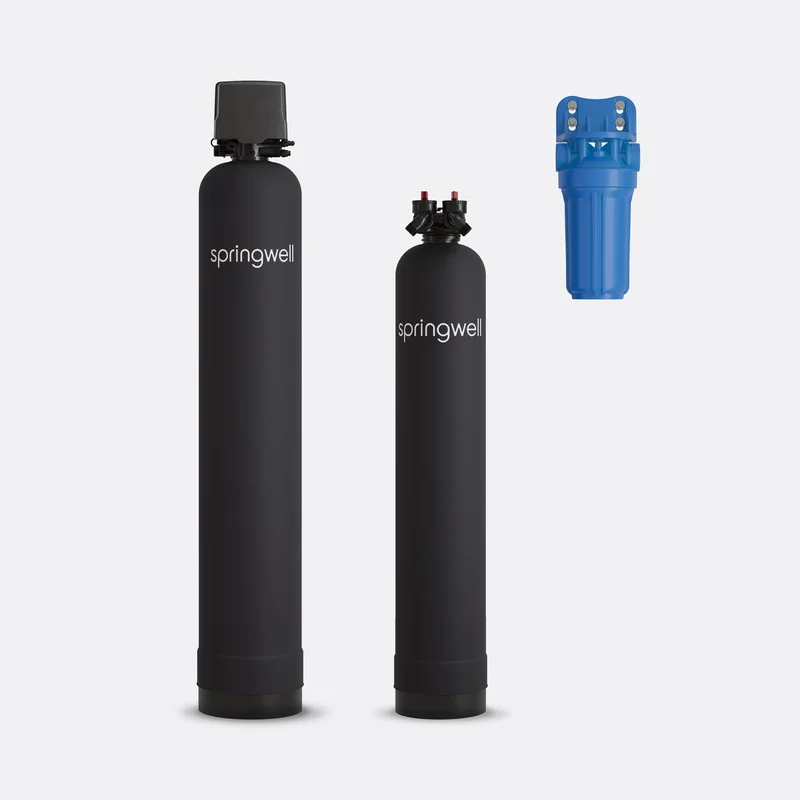
SpringWell · Combination system · $3,213 (sale) at SpringWell as of Oct 2026
- Treats
- Iron, Manganese, Sulfur, Hardness
- Flow
- 12 GPM
- Capacity
- —
- Install
- DIY
- Warranty
- Lifetime
WS1 iron filter plus FS1 salt-free conditioner in one order, both 12 GPM, with lifetime warranty and a $567 saving over separate list prices. Conditioner limits scale but leaves hardness in the water.
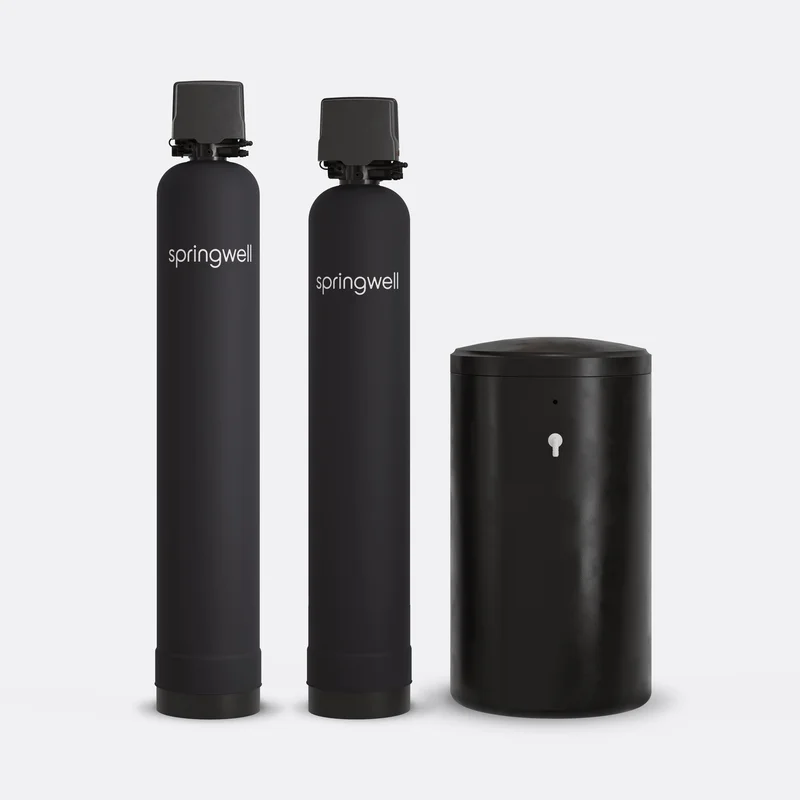
SpringWell · Combination system · $3,124 (sale) at SpringWell as of Oct 2026
- Treats
- Iron, Manganese, Sulfur, Hardness
- Flow
- 11 GPM
- Capacity
- 32,000 gr
- Install
- DIY
- Warranty
- Lifetime
WS1 iron filter plus SS1 32,000-grain softener with Bluetooth heads and a lifetime warranty, $680 less than buying separately. Two drains, two outlets and salt; service flow limited to 11 GPM.
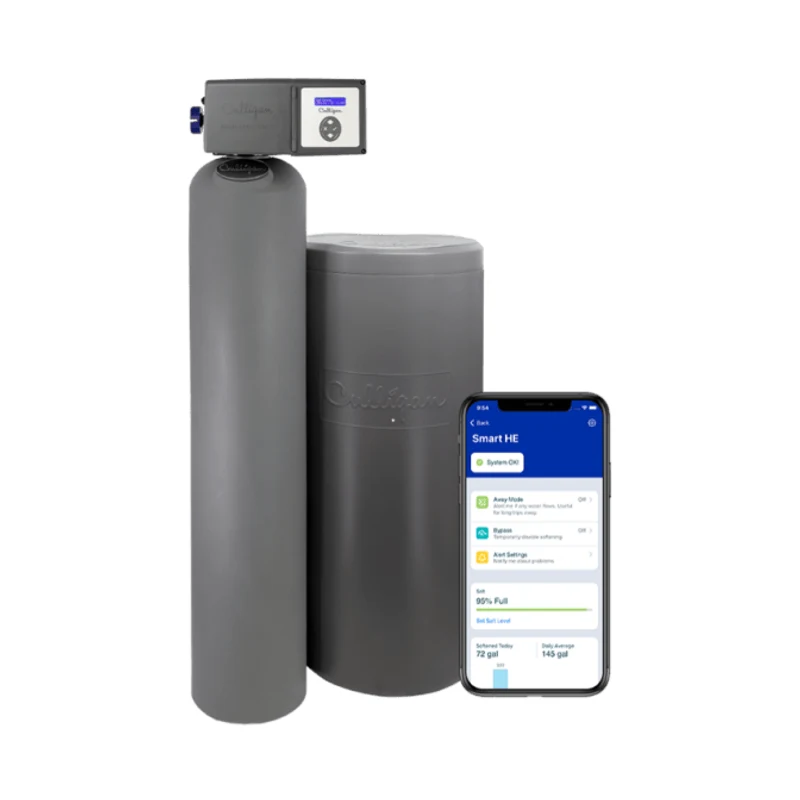
Culligan · Water softener · Dealer quote only
- Treats
- Hardness, Iron
- Flow
- 9 GPM
- Capacity
- 25,823 gr
- Install
- Professional
- Warranty
- 10-year
Dealer-installed softener certified by WQA to NSF/ANSI 44 for hardness, barium and radium, with lifetime tank and resin warranty and app control. Pricing by dealer quote; iron tolerance to 5 ppm is uncertified.
Sold through authorized dealers only; pricing is by in-home quote.
Full specs →
Kinetico · Water softener · Dealer quote only
- Treats
- Hardness, Iron
- Flow
- 11.5 GPM
- Capacity
- 14,686 gr
- Install
- Professional
- Warranty
- 10-year
Non-electric twin-tank softener certified by WQA to NSF/ANSI 44 with a 10-year all-parts warranty that includes the resin. Dealer-only, pricing by dealer quote; 11.5 gpm and per-cycle capacity appear only in Kinetico's performance data sheet.
Sold through authorized dealers only; pricing is by in-home quote.
Full specs →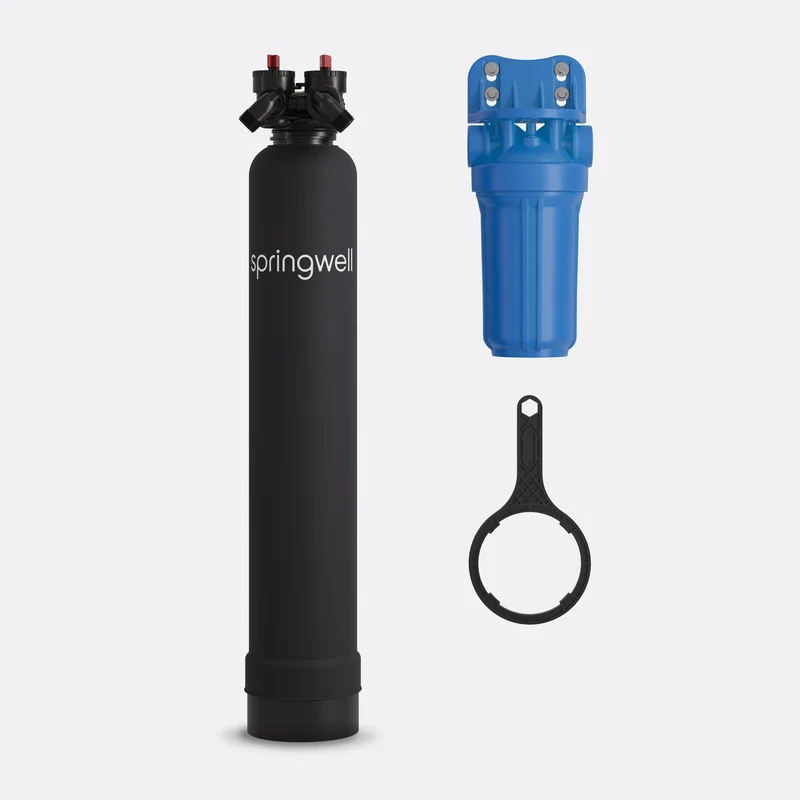
SpringWell · Water softener · $1,785 (sale) at SpringWell as of Oct 2026
- Treats
- Hardness
- Flow
- 12 GPM
- Capacity
- —
- Install
- DIY
- Warranty
- Lifetime
Salt-free TAC conditioner rated 12 GPM and up to 81 gpg in a 6 in. tank with no drain or power. Prevents up to 95% of scale per SpringWell (uncertified); does not remove hardness minerals.
SpringWell · Water softener · $1,607 (sale) at SpringWell as of Oct 2026
- Treats
- Hardness
- Flow
- 11 GPM
- Capacity
- 32,000 gr
- Install
- DIY
- Warranty
- Lifetime
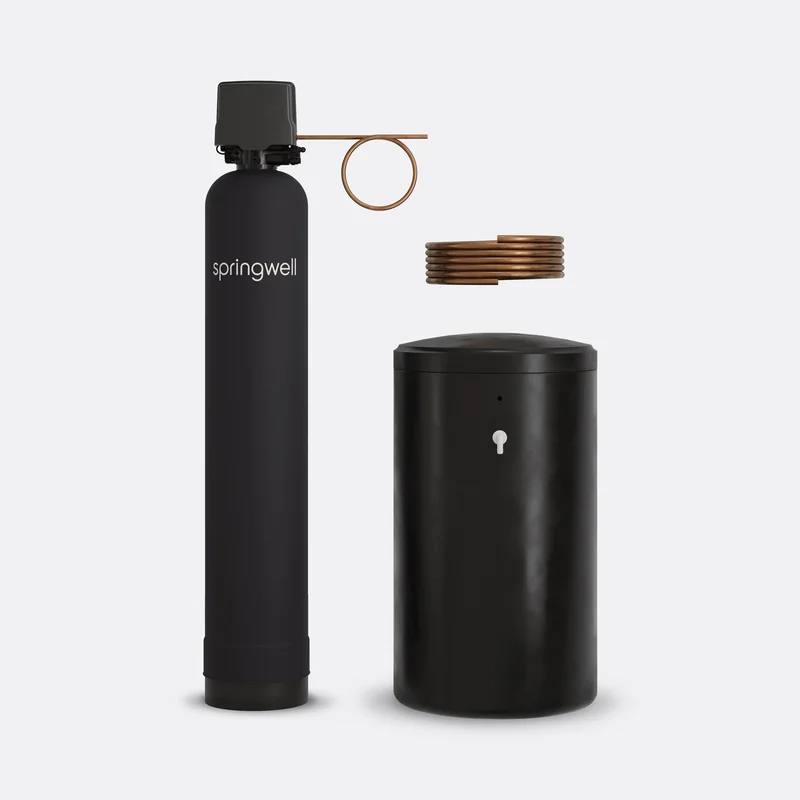
32,000-grain metered ion-exchange softener at 11 GPM with a Bluetooth head, lifetime tank and valve warranty and 5 years on the electronic head per the product page (7 per the warranty page). Needs salt, drain and power; no NSF/ANSI 44 certification.
Pick by grain load first: compensated hardness in gpg times people times 75 gallons a day, covered for about a week. Under about 2 mg/L of dissolved iron, a metered softener with a sediment filter ahead of it is the whole system; above that, pair an iron filter with the softener or look at a combo unit. If scale on the heater is the only complaint and the well has no iron, a conditioner avoids the salt. The sizing tool turns your test result into a capacity.
Before you buy
- Test hardness with a strip or titration kit, and get iron, manganese, pH and TDS from a certified lab (testing guide).
- Compute compensated hardness if iron is present, then run the sizing tool for capacity and flow rate.
- Compare metered softeners and combo systems on the best well water filters list.
- If you need an iron filter and a softener, or a drain line is a problem, get a quote from a local installer.
- Retest hardness at a tap after the softener once it is running; a correctly set unit reads near zero.