If your well water smells like rotten eggs, you are smelling hydrogen sulfide gas (H2S), usually strongest when a tap first opens. The one-sentence answer: find out whether the odor is in hot water only, in both hot and cold, or only after the water sits in the pipes, because each points to a different cause and a different fix, and only one of them is a filter. Many rotten-egg complaints come from the water heater, and the cure is a new anode rod, not a filter.
What causes it: why well water smells like rotten eggs
The Minnesota Department of Health groups the sources into three: natural decay and chemical reactions between groundwater and the soil and rock around the well, sulfur bacteria living in the groundwater, the well or the plumbing, and chemical reactions inside the water heater.
The aquifer. Penn State Extension notes that sulfur-reducing bacteria thrive in low-oxygen groundwater, particularly in acidic bedrock such as shale and sandstone; Virginia Cooperative Extension adds wells near coal or oil fields. The bacteria feed on sulfate and release hydrogen sulfide, which stays dissolved under pressure and flashes off when the tap opens.
Sulfur bacteria in the system. The same bacteria can colonize the casing, pressure tank, softener resin or water heater. Minnesota DOH lists the signs: white, grey, black or reddish-brown slime, black stains on silverware and fixtures, and corroded pipes.
The water heater. Water heaters contain a magnesium anode rod that sacrifices itself to protect the steel tank. Penn State explains that this rod can chemically convert sulfate in otherwise odor-free water into hydrogen sulfide. The well is fine; the heater stinks.
How to tell the well from the water heater
Before you spend anything, do the test Minnesota DOH recommends. Let the water sit unused for several hours, then smell a cold tap, close it, and smell a hot tap.
| What you smell | Likely source | Fix |
|---|
| Hot water only | Magnesium anode rod reacting with sulfate, or bacteria in the heater | Replace the anode, flush and disinfect the heater |
| Both hot and cold, but not at a tap ahead of the softener | Sulfur bacteria in the softener resin | Disinfect the softener |
| All taps, and the smell stays after running the water | Hydrogen sulfide dissolved in the groundwater | Whole-house treatment |
| All taps, but the smell fades after running the water a while | Sulfur bacteria in the well or plumbing | Shock chlorinate the well and plumbing |
The hot-water-only case
If the odor is only in hot water, the well is usually not the problem and no filter will help. The source is the water heater: either the magnesium anode rod reacting with sulfate, or sulfur bacteria growing in the tank. Penn State and Virginia Tech both point to the anode rod first and both recommend replacing it with an aluminum rod, which still protects the tank. Aluminum-zinc and powered (electronic) anodes are the usual replacements, and a handy owner can swap one in an afternoon. For a heater that has grown bacteria, Minnesota DOH adds two options: disinfect it with chlorine bleach, or run it at 160°F for several hours and then turn it back down, minding the scald risk and the manufacturer's instructions.
Smell that fades as the water runs
If every tap smells at first and then clears, bacteria are growing in the well or plumbing rather than arriving with the groundwater. Shock chlorination, which Minnesota DOH says should be done by a licensed contractor, often clears this, but Penn State cautions that the odor usually returns without continuous treatment. If it comes back within weeks, plan on a permanent system.
Is it a health risk?
Not at the levels you can drink. The EPA has no drinking water standard for hydrogen sulfide at all, neither a health-based MCL nor a secondary standard. The closest federal number is the EPA secondary standard for odor, a non-enforceable aesthetic guideline of 3 threshold odor number, with "rotten-egg" smell listed as the noticeable effect. Penn State makes the practical point: most people smell hydrogen sulfide well below 0.5 mg/L, so water becomes undrinkable long before it becomes harmful. Virginia Tech notes that about 1.0 mg/L can corrode plumbing and tarnish copper and silverware.
The real safety concern is air. Minnesota DOH warns that the gas can be harmful at high levels and can collect in well pits and other enclosed, low-lying spaces. Do not climb into a well pit to investigate a smell.
Sulfur bacteria are not a health concern, per Minnesota DOH, but a well that grows them may be open to other bacteria. If you have not tested for total coliform in the past year, add it; see the bacteria page.
How to test for hydrogen sulfide
Hydrogen sulfide is a gas and it leaves the sample; a bottle mailed to a lab can come back clean even when the water reeks.
- Find where the smell comes from. Run cold water only at a sink and smell it, then hot water only. Smell in hot water alone usually means the water heater: the magnesium anode rod reacting with sulfate, or sulfur bacteria in the tank. The fix is a replacement aluminum-zinc or powered anode and a flush, not a filter. Smell in both means the well.
- Check the softener and heater. If the house has a softener, smell water before and after it. Bacteria can colonize resin and heaters; shock-chlorinating the well and flushing the heater sometimes clears a mild odor.
- Test at the wellhead. Hydrogen sulfide escapes as gas within minutes, so a mailed sample is unreliable. Use a field test kit at the spigot nearest the well, or have a lab technician test on site. Order sulfate and sulfate-reducing bacteria as well.
- Match the level to a treatment. There is no EPA health limit for hydrogen sulfide; the odor threshold is below 0.5 mg/L. Air-injection and catalytic carbon filters are rated for a maximum H2S level in mg/L, so you need the number before you buy.
Penn State is explicit that field testing or a chemically stabilized sample is required because the gas dissipates in transport. Add iron, manganese and pH to the order; they travel with hydrogen sulfide in low-oxygen wells, and the single-tank filters that handle one usually handle the others. Our testing guide covers choosing a certified lab.
Treatment options
The right treatment depends on the concentration and on whether bacteria are involved.
Air-injection oxidizing filter
A single tank with a pocket of compressed air in the head. Water sprays through the air, hydrogen sulfide oxidizes to elemental sulfur, and the media bed catches the particles until the valve backwashes them to drain. Minnesota DOH lists oxidizing media filtration as effective up to about 6 mg/L, and the same unit removes iron and manganese in the same pass. This is the standard whole-house answer when the smell is in cold water and the well also has iron. It needs no chemicals, only power for the valve and a drain for backwash. Put a sediment filter ahead of it if the well pumps grit. Manganese greensand, the older chemically regenerated version, is rated to 6 mg/L by Virginia Tech but needs potassium permanganate and a dealer.
Catalytic activated carbon
Carbon with a catalytic surface that converts hydrogen sulfide rather than only adsorbing it. Minnesota DOH and Penn State rate activated carbon for levels under about 1 mg/L; Virginia Tech is more conservative at trace levels to 0.1 mg/L. It suits a faint odor with no iron. The carbon bed is consumed and must be replaced on a schedule; when the smell returns, the bed is spent.
Chlorination or peroxide injection with a contact tank
Above about 6 mg/L, Penn State and Virginia Tech both point to injecting an oxidizer (chlorine or potassium permanganate) followed by filtration. A feed pump doses the oxidizer ahead of a retention tank, which gives it time to convert the sulfide and kill sulfur bacteria; a carbon filter downstream removes the residual. It is also the answer when bacteria keep re-colonizing the well after shock treatment. Dealer-installed, with chemical to refill.
Water heater anode replacement
For odor only in hot water, swap the magnesium anode for an aluminum, aluminum-zinc or powered anode, then flush and disinfect the heater. Not a filter, and not a product we rank.
Installation order matters: sediment first, then the oxidizing filter or chlorination stage, then a softener if needed (see hard well water), and UV last if the well has a bacteria problem.
Systems that treat sulfur odor
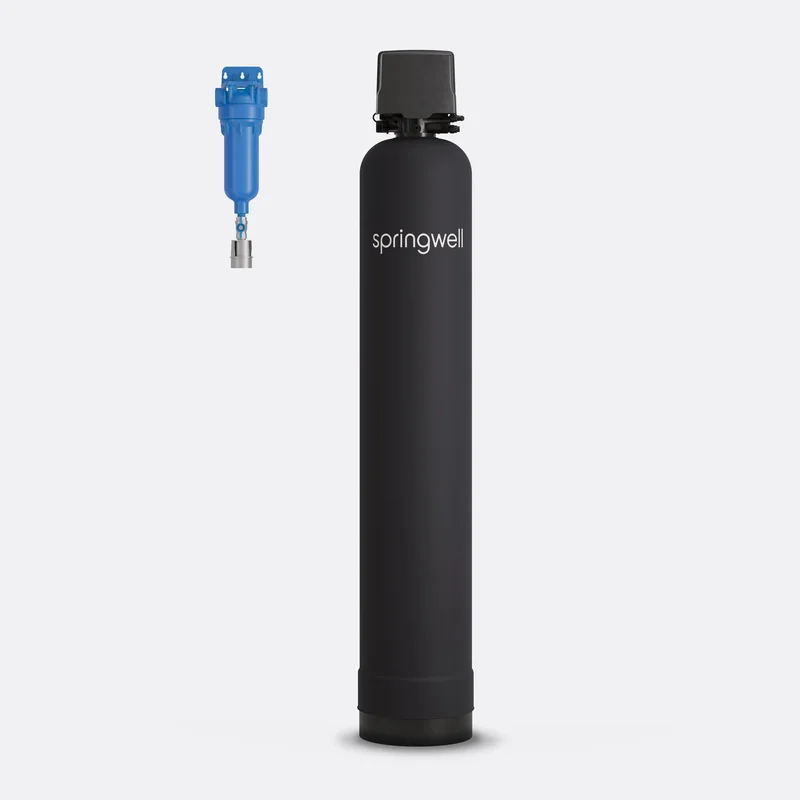
SpringWell · Iron filter · $2,231 (sale) at SpringWell as of Oct 2026
- Treats
- Iron, Manganese, Sulfur
- Flow
- 12 GPM
- Capacity
- —
- Install
- DIY
- Warranty
- Lifetime
Single-tank air-injection filter rated for iron to 7 ppm, hydrogen sulfide to 8 ppm and manganese to 1 ppm at 12 GPM, with a lifetime tank and media warranty. No NSF certification; needs a drain and power.

US Water Systems · Iron filter · $2,983 (sale) at US Water Systems as of Oct 2026
- Treats
- Iron, Manganese, Sulfur
- Flow
- 10 GPM
- Capacity
- —
- Install
- DIY or pro
- Warranty
- 10-year
Peroxide-injection and catalytic carbon system rated for iron to 20 ppm, hydrogen sulfide to 30 ppm and pH 6-9 at 10 GPM, with a lifetime tank warranty. Needs peroxide refills; no system-level certification.
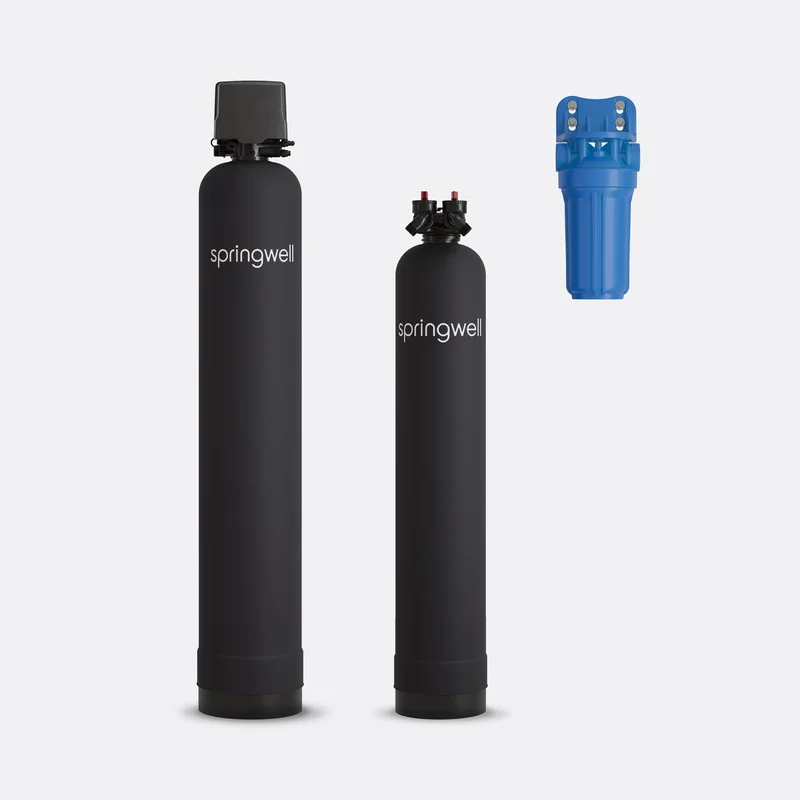
SpringWell · Combination system · $3,213 (sale) at SpringWell as of Oct 2026
- Treats
- Iron, Manganese, Sulfur, Hardness
- Flow
- 12 GPM
- Capacity
- —
- Install
- DIY
- Warranty
- Lifetime
WS1 iron filter plus FS1 salt-free conditioner in one order, both 12 GPM, with lifetime warranty and a $567 saving over separate list prices. Conditioner limits scale but leaves hardness in the water.
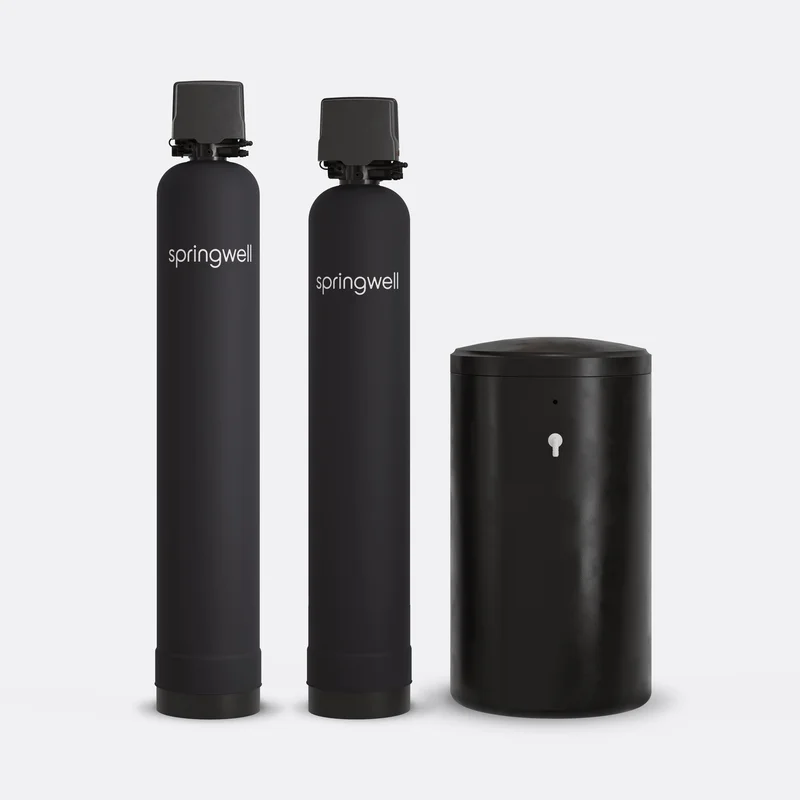
SpringWell · Combination system · $3,124 (sale) at SpringWell as of Oct 2026
- Treats
- Iron, Manganese, Sulfur, Hardness
- Flow
- 11 GPM
- Capacity
- 32,000 gr
- Install
- DIY
- Warranty
- Lifetime
WS1 iron filter plus SS1 32,000-grain softener with Bluetooth heads and a lifetime warranty, $680 less than buying separately. Two drains, two outlets and salt; service flow limited to 11 GPM.
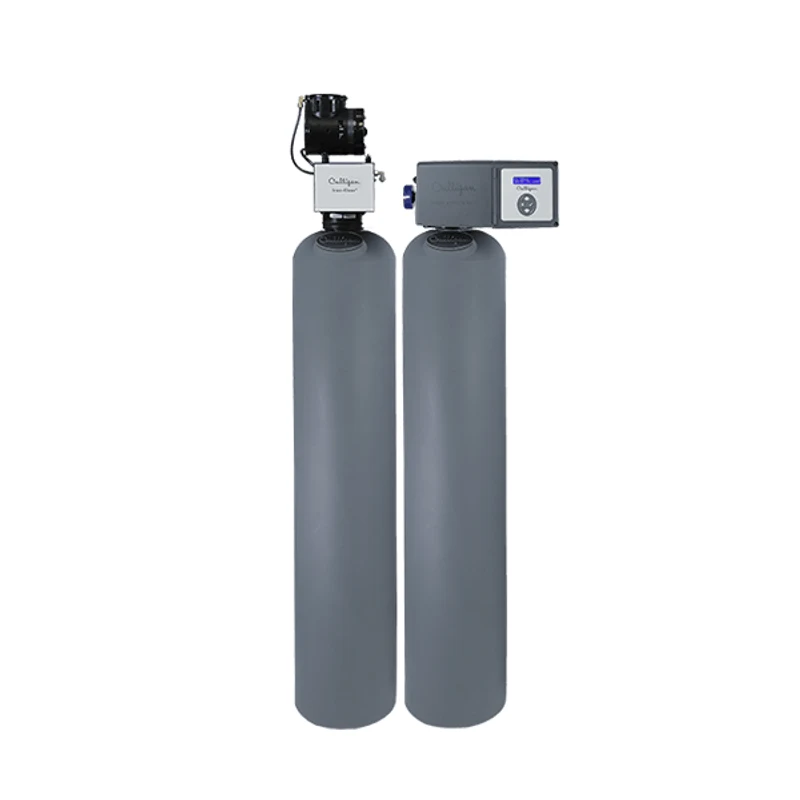
Culligan · Iron filter · Dealer quote only
- Treats
- Iron, Manganese, Sulfur
- Flow
- 4 GPM
- Capacity
- 1,400 gal
- Install
- Professional
- Warranty
- 10-year
Dealer-installed two-tank aeration and birm filter rated for iron to 10 ppm and sulfide to 5 ppm, with WQA certification to NSF/ANSI 42 for iron reduction. Pricing by dealer quote; 4-6 gpm service flow; pH 7.0-8.5 only.
Sold through authorized dealers only; pricing is by in-home quote.
Full specs →Kinetico · Iron filter · Dealer quote only
- Treats
- Iron, Manganese, Sulfur
- Flow
- 5 GPM
- Capacity
- —
- Install
- Professional
- Warranty
- 10-year
Dealer-installed air-injection filter in a 10 by 54 in. tank with iron media (iron to 7 ppm, sulfide to 0.5 ppm) or sulfur media (sulfide to 6 ppm, iron to 2 ppm). Pricing by dealer quote; 5 gpm service flow.
Sold through authorized dealers only; pricing is by in-home quote.
Full specs →Choose by your field-test number and by what else is in the water. If iron or manganese is present with hydrogen sulfide under about 6 mg/L, one air-injection tank handles all three. If the odor is faint and the water is otherwise clean, a catalytic carbon tank is cheaper to run. Use the sizing tool to match the tank to your peak flow; an undersized oxidizing filter lets odor through at the shower.
Before you buy
- Confirm the source with the hot-and-cold test; if it is the heater, replace the anode before looking at filters.
- Get a field test for hydrogen sulfide and a lab test for iron, manganese, pH and total coliform (testing guide).
- Compare the systems on the best well water filters list against your numbers, and run the sizing tool for flow rate and tank size.
- If the well needs shock chlorination or a chemical-feed system, find a local installer.
- Retest treated water after installation; only a retest shows what the system did to your water.