This page contains affiliate links. If you buy through them we may earn a commission at no extra cost to you. How we make money
Tannins in Well Water: Why It Is Yellow, How to Tell It From Iron, and What Removes It
Yellow to tea-colored water that stays colored after standing. Harmless, but it stains and it fouls other filters.
Water that comes out of the tap yellow, amber or the color of weak tea, and stays that way no matter how long it sits, is almost always tannins in well water. They are dissolved organic matter from decaying vegetation, harmless to drink, but they stain laundry and porcelain and foul the other equipment on the line. The fix is usually a tannin-removal anion exchange tank installed after the iron filter and softener, and the job before buying anything is a jar test and a lab test to make sure the color is not iron.
What causes tannins in well water
Tannins (lignins and humic substances; labs often report them together) come from water percolating through peat, leaf litter, swamp muck and organic-rich topsoil. The University of Wisconsin's well-water guide puts it simply: tannins are picked up when water passes through soils with high organic matter content or decaying vegetation. That makes it a shallow-well problem. A deep bedrock well rarely has it; a dug well, a sand point or a shallow drilled well in a wooded, swampy, peaty or coastal-plain area often does. It is common across the Southeast coastal plain, Florida, the upper Midwest and New England, anywhere groundwater sits close to wetland soils.
How to tell tannins from iron
Yellow water is iron more often than it is tannin, and the two need completely different equipment, so sort this out first.
The jar test. Fill a clear glass jar from a cold tap and let it stand overnight. Dissolved ferrous iron starts clear and turns orange or red-brown as it meets air, then drops particles to the bottom; Virginia Tech describes it as water that is clear at first but develops rust-colored particles that settle on standing. Tannin water is colored from the moment it leaves the tap, stays evenly yellow to brown overnight, and leaves nothing on the bottom.
The coffee-filter test. Pour the standing water through a paper coffee filter. Particulate iron, oxidized manganese and sediment stay on the paper; dissolved tannin passes through and the filtrate is still yellow.
The complication: organic iron. Iron can bind to tannins and stay in solution as a yellow or brown complex that neither settles nor oxidizes. The Minnesota Department of Health notes that organic iron is usually yellow or brown and that organic iron and tannins can slow or prevent iron oxidation, so water softeners, aeration systems and iron filters may not work well. Virginia Tech's treatment table files color that remains longer than 24 hours under colloidal or organically complexed iron and sends it to chemical oxidation followed by filtration. If the jar test is ambiguous, this is why you also order the lab test.
The lab test. Ask a certified lab for tannins (lignin), iron, manganese, pH, hardness and color in color units. Tannin is reported in mg/L. The iron number tells you whether you have one problem or two.
Is it a health risk?
No. Tannins have no health-based limit, and no EPA or CDC guidance treats them as one. The relevant federal number is aesthetic: the EPA secondary standard for color is 15 color units. Secondary standards are non-mandatory; the EPA does not enforce them, and they exist because above those levels most people find the water objectionable. The EPA describes the effect above 15 units as a visible tint and ties color to dissolved organic material and a high disinfectant demand.
That last point is the real cost of tannins. They are harmless to drink, but they consume chlorine, foul softener resin and carbon beds, and block UV light. Wisconsin's guide lists tannins first among the things that block light and must be removed before UV disinfection. If your well also has a bacteria problem, tannins can make the UV system that protects you less effective.
How to test for tannins
Tannins are a lab test with a home screen in front of it.
Rule out iron with a jar test. Fill a clear jar and let it stand overnight. Iron settles or turns the water orange; tannin stays evenly yellow to brown. Color that filters out through a coffee filter is particulate; color that passes through is dissolved tannin.
Order tannin, iron and color from a lab. Ask a certified lab for tannins (lignin), iron, pH, hardness and color in color units. Tannins are reported in mg/L; the EPA secondary standard for color is 15 color units.
Check for surface influence. Tannin usually means the well draws water that recently passed through soil and vegetation. Add total coliform to the test; a shallow well with tannins is more likely to have bacteria too.
Treat iron and hardness first. Tannin-removal resin is fouled by iron and competes with hardness, so the usual order is sediment, iron filter, softener, then tannin unit. Give the lab results to the treatment dealer; tannin systems are sized case by case.
Sample from a cold tap ahead of any softener or filter, after flushing the line, and add E. coli alongside the coliform test; if bacteria turn up, the fix starts with the well, not a filter. The well water testing guide explains how to find a certified lab and what else to add to the panel.
Treatment options
Three approaches work, and they are not interchangeable. Which one fits depends on the tannin level, the iron level and whether bacteria are also in play.
Tannin-removal anion exchange resin
The standard answer. A softener-style tank holds a macroporous strong-base anion resin that captures the negatively charged organic molecules and releases them to drain during a salt-brine regeneration. The Wisconsin guide lists anion exchange first for tannins and explains the mechanism: the resin exchanges chloride for negatively charged ions in the water.
The resin has two enemies. Iron coats it and ends its life early, which is why an iron filter goes upstream. Hardness competes for it and limits capacity, which is why the softener goes upstream; the University of Wisconsin's buying guide states that anion exchange devices should only be served by soft water. Expect to add salt and have the resin bed replaced on a schedule the dealer sets from your water. Treated water carries some added chloride and can be slightly more corrosive; a lab retest after installation confirms the color is gone and tells you where the pH landed.
Oxidation plus filtration
Chlorine or ozone injected ahead of a contact tank breaks down tannins and oxidizes any iron bound to them, and a carbon or media filter downstream catches the result and strips the residual chlorine. This is the route when the lab says organic iron, when the water also needs disinfecting, or when tannin levels are too high for resin alone. Virginia Tech and the University of Nebraska both point to chemical oxidation followed by filtration when iron is combined with organic matter. Dealer-installed; the Wisconsin guide notes that a carbon filter after chlorination is needed to remove excess chlorine and the byproducts that form when chlorine meets organics.
Activated carbon (low levels only)
Carbon adsorbs color. The Water Quality Association's technical sheet says color bodies such as tannins are high molecular weight organics that can be removed by GAC, with wood-based carbons having the longest record for de-colorization, and warns the product has to be chosen with the right pore structure. The catch is capacity: a whole-house carbon tank on strongly colored water exhausts quickly and you cannot see it happen. Carbon is reasonable for a light tint and the musty taste that comes with it, and as the polishing stage after oxidation. For serious color, plan on resin.
Treatment order
Tannin units are the last mineral stage on the line and go before any UV:
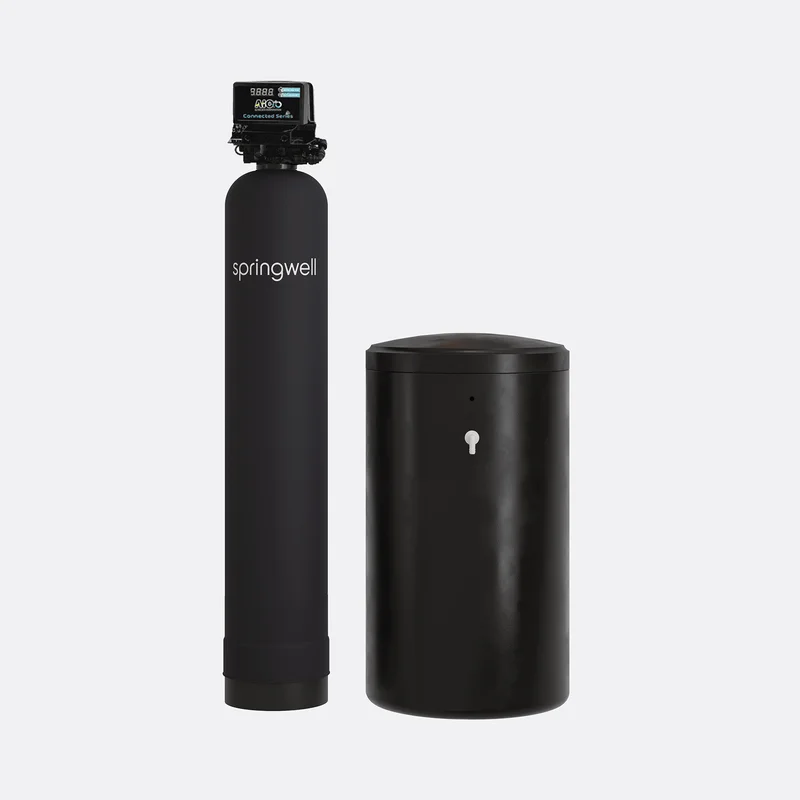
SpringWell · Water softener · $2,788 (sale) at SpringWell as of Oct 2026
Treats
Tannins, Hardness
Flow
12 GPM
Capacity
30,000 gr
Install
DIY
Warranty
Lifetime
One tank for tannins and hardness: 12 GPM, 30,000 grains, 1 in. connections, $2,787.62 on sale, lifetime tank and valve warranty. Not for iron, manganese or sulfur without pre-treatment; no certification or tannin limit published.
US Water Systems · Water softener · $2,195 (sale) at US Water Systems as of Oct 2026
Treats
Tannins
Flow
10 GPM
Capacity
—
Install
DIY
Warranty
Lifetime
Whole-house anion-exchange tannin tank, 1.0 cu ft at 10 GPM (2.0 cu ft at 20 GPM), $2,195 on sale, lifetime tank warranty. Does not soften or remove iron; softener first above 5 gpg. Tannin figure is a maker claim.
Pick by the lab sheet. Low tannin, no iron, light tint: a whole-house catalytic carbon tank may be enough, with a short media life. Moderate tannin with hardness: a softener plus a tannin anion tank, in that order. High tannin, organic iron or bacteria: an oxidation-and-filtration system from a dealer, with carbon behind it. Run your household flow through the sizing tool so each tank is sized to peak demand rather than guessed.
Before you buy
Get the jar test and the lab report done first; a yellow glass is not enough to spend money on. Compare whole-house options on the best well water filters page, size every stage with the sizing tool, and read how to test well water so the before-and-after samples are comparable. Because tannin treatment almost always means two or three tanks in a specific order, and often chemical feed, it is a sensible job for a licensed installer even if you handle the sediment stage yourself. Then retest.
Frequently asked questions
How do I know if my yellow well water is tannins or iron?+
Fill a clear jar and let it stand overnight. Dissolved iron starts clear and turns orange or red-brown, then drops particles to the bottom. Tannin water is colored from the tap, stays evenly yellow to brown and leaves nothing on the bottom. Pour it through a coffee filter: particulate iron stays on the paper, dissolved tannin passes through. Confirm with a lab test for tannin, iron and color, because organic iron bound to tannins can look like either.
Are tannins in well water harmful?+
No. Tannins have no health-based limit. The only federal number is the EPA secondary standard for color, 15 color units, which is non-enforceable and based on appearance. The practical problems are staining of laundry and porcelain, a musty taste, and fouling of softener resin, carbon and UV systems downstream.
What removes tannins from well water?+
A tannin-removal anion exchange tank, a softener-style unit with macroporous anion resin regenerated with salt, is the standard treatment. Chlorine or ozone oxidation followed by a carbon or media filter is used when organic iron or bacteria are also present. Activated carbon works for low tannin levels and the taste that comes with them but exhausts quickly on strongly colored water.
In what order should tannin treatment be installed?+
Sediment filter first, then iron and manganese filter, then water softener, then the tannin anion-exchange tank, then UV if needed. Iron fouls tannin resin and hardness competes with it, so both go upstream; tannins block UV light, so the UV goes downstream of the tannin unit.
Will a water softener or iron filter get rid of tannins?+
Not reliably. A softener removes calcium and magnesium, not organic color, and the Minnesota Department of Health notes that organic iron and tannins can slow or prevent iron oxidation, so softeners, aeration systems and iron filters may not work well on that water. Tannins need anion resin, oxidation or carbon.
Sources
Figures and quotations above come from these pages as read on 2026-10-05. These are reference links, not affiliate links.