Orange rings in the toilet, rust streaks on white laundry, coffee that tastes like a penny. Iron is the most common complaint on private wells in the US, and the fix depends on one thing most people skip: which form the iron is in. Choosing an iron filter for well water starts with a lab number and a look at how the water behaves in a glass, not with a product page. The short answer: dissolved iron needs an oxidizing filter; iron that is already rust needs a sediment filter; iron bacteria need the well cleaned first.
What causes iron in well water
Iron is in nearly all soil and rock. The USGS groundwater quality page puts it plainly: as groundwater flows through sediments, metals such as iron and manganese are dissolved and can reach high concentrations. Where the aquifer is low in oxygen, iron stays in its dissolved ferrous (Fe2+) form until it reaches air at your tap, which is why water can look clear coming out and orange an hour later.
Three other sources are worth ruling out:
- Corroding steel casing or iron plumbing. Old galvanized pipe sheds rust that shows up as flakes, not as dissolved iron. A sediment filter and, eventually, repiping are the answer; see the sediment page.
- Iron bacteria. Harmless organisms that feed on dissolved iron and leave a rusty, sticky slime in toilet tanks and on pump parts. They complicate every treatment below.
- Regional geology. Penn State Extension's iron and manganese guide found excessive iron in 17 percent of the private water supplies it sampled across Pennsylvania. Your neighbors' water is a good predictor of yours.
How to tell iron from manganese, tannins and iron bacteria
Virginia Tech's iron and manganese publication describes the dissolved forms as clear at first, forming black or rust-colored particles on standing, and the particulate forms as giving the tap water a brownish-black, rust, red or yellow color straight away.
| Symptom | Most likely | Treatment family |
|---|
| Clear at the tap, orange after standing; orange-red stains | Ferrous (dissolved) iron | Oxidizing filter or, at low levels, a softener |
| Orange or rusty water at the tap, visible particles | Ferric (particulate) iron | Sediment filter; find the corrosion source |
| Black, brown-black or purple stains; iron tests low | Manganese | Catalytic oxidizing filter |
| Uniform yellow to tea color that never settles | Tannins | Anion exchange resin |
| Rusty slime in the toilet tank, oily sheen, swampy or musty smell | Iron bacteria | Shock chlorination, then filtration |
| Rotten-egg smell with black stains on silverware | Hydrogen sulfide | Air-injection or catalytic carbon |
Iron bacteria deserve their own check. The University of Georgia's bacteria bulletin suggests filling a clear container from a little-used tap and leaving it 24 hours: a thin rusty layer means little or no bacteria, while rust-colored fluffy strands mean a substantial colony. The Minnesota Department of Health's iron bacteria page adds an oil-like sheen and feathery growths as signs, and says a lab test can confirm it.
Is it a health risk?
For almost everyone, no. Iron has no enforceable health limit. The EPA's secondary drinking water standard for iron is 0.3 mg/L, and the listed effects are rusty color, sediment, metallic taste and reddish or orange staining. A secondary standard, or SMCL, is a non-enforceable guideline for aesthetics; it is not a maximum contaminant level (MCL) for health, and private wells are not regulated at all.
Two caveats. Virginia Tech notes that people with hemochromatosis, a condition in which the body stores excess iron, may be especially sensitive to iron in drinking water. And iron rarely travels alone: manganese, which does have a health advisory, is usually in the same water, which is why a lab panel beats a strip test. Staining starts low. North Dakota State University's iron and manganese removal guide says stains become noticeable when dissolved iron passes about 0.2 mg/L.
How to test for iron in well water
Iron filters are rated and sized by concentration, pH and the presence of manganese, so you need numbers, not a color chart.
- Note how the water looks at the tap. Clear water that turns orange after standing is dissolved ferrous iron. Water that is already orange or has visible particles is ferric iron. Reddish slime or an oily sheen points to iron bacteria. The form of iron decides the treatment.
- Order a lab test for iron, manganese, pH and hardness. Use a state-certified laboratory; a basic well panel usually includes all four. Iron filters are sized and chosen by the total iron concentration in mg/L, the pH and whether manganese is present, so a strip test is not enough.
- Take the sample correctly. Sample from an outside spigot or a tap before any existing treatment, after running the water for several minutes, into the lab's bottle. Some labs want the sample acidified for metals; follow their instructions.
- Compare to the limits. The EPA secondary standard for iron is 0.3 mg/L. Staining typically starts above that level. Most iron filters are rated for a maximum iron level; check the product's rating against your number before buying.
The EPA and the CDC both say to test private wells once a year for coliform bacteria, nitrate, total dissolved solids and pH, using a certified lab. Add iron, manganese and hardness to that order. The testing guide covers how.
Treatment options
The higher the iron, the more oxidation you need. Virginia Tech's table runs from a softener for up to 5 mg/L of combined iron and manganese, through aeration plus filtration at 5 to 10 mg/L, to an oxidizing filter for up to 15 mg/L and chemical oxidation with filtration above 10 mg/L. In every case, put a sediment filter first.
Air-injection oxidizing filter
A single tank that holds a pocket of compressed air at the top. Water sprays through the air, dissolved iron oxidizes to solid rust, and the media bed below catches it. On a schedule the valve backwashes the rust to drain and draws in fresh air. No chemicals, no consumables beyond electricity and backwash water. This is the standard whole-house answer for ferrous iron and it usually handles manganese and hydrogen sulfide in the same pass. It needs a drain, a backwash flow rate your pump can supply (check it with the sizing tool), and pH near neutral or above. Iron bacteria will foul the bed, so shock the well first.
Manganese greensand or catalytic media filter
A media bed (greensand or a manganese-dioxide coated media) that catalyzes oxidation on the grain surface. Penn State recommends greensand or similar oxidizing filters for 3 to 10 mg/L of combined iron and manganese; NDSU says greensand handles iron up to 10 mg/L and wants pH above 6.8, with a calcite neutralizer ahead of it when the water is acidic. Greensand is regenerated with potassium permanganate or a chlorine feed, which is why this is usually a dealer-installed system. Above about 10 mg/L, both Penn State and NDSU move to chemical oxidation (chlorine) with a contact tank and a filter; NDSU puts the optimal pH for chlorine oxidation of iron at 8.0.
Water softener (low iron only)
Ion exchange resin removes small amounts of dissolved ferrous iron along with hardness. Penn State lists softening as an option when pH is above 6.7, hardness is 3 to 20 grains per gallon and dissolved iron is under 5 mg/L; NDSU notes that some softeners are limited to 2 mg/L, so read the maker's rating. Ferric iron and iron bacteria coat the resin, so a softener on iron water needs a sediment filter ahead of it. If iron is above the rating, put an iron filter first and let the softener do only hardness.
Sediment filter (ferric iron only)
If the iron is already oxidized particles when it reaches the house, a 5 micron or finer cartridge or a backwashing sediment filter catches it. It does nothing for dissolved iron, which passes through and turns orange downstream.
Iron bacteria: clean the well first
No filter removes a colony living in the well. The Minnesota Department of Health describes shock chlorination at close to but not above 200 ppm of chlorine after the pump and casing have been physically cleaned; UGA recommends 500 ppm specifically for iron bacteria, repeated each spring and fall. Both say iron bacteria are a nuisance, not a health risk. Follow your state extension office's procedure, flush the chlorine out, then start treatment.
Systems that treat iron: choosing an iron filter for well water
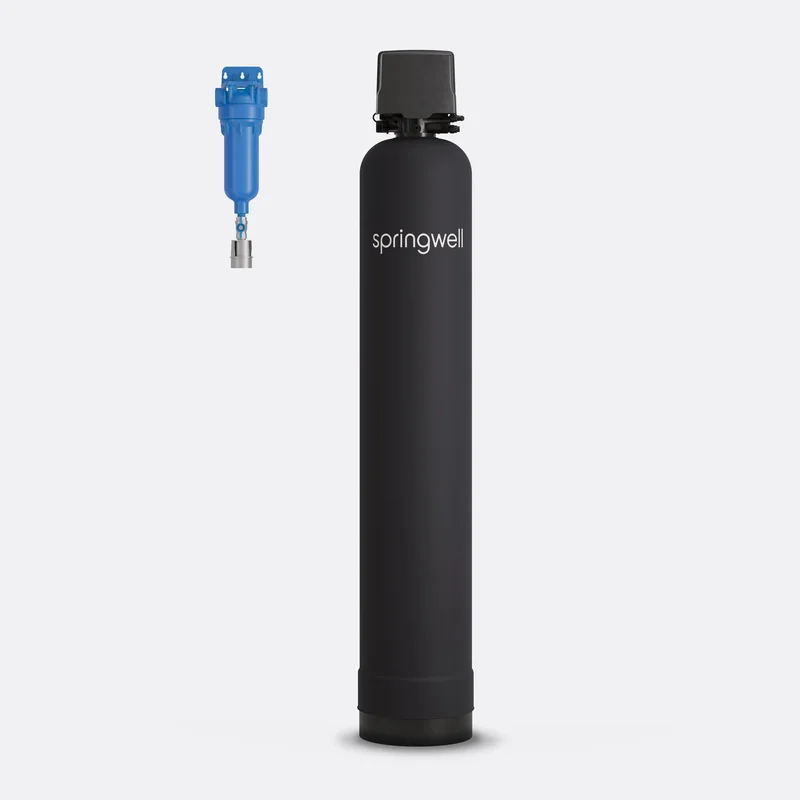
SpringWell · Iron filter · $2,231 (sale) at SpringWell as of Oct 2026
- Treats
- Iron, Manganese, Sulfur
- Flow
- 12 GPM
- Capacity
- —
- Install
- DIY
- Warranty
- Lifetime
Single-tank air-injection filter rated for iron to 7 ppm, hydrogen sulfide to 8 ppm and manganese to 1 ppm at 12 GPM, with a lifetime tank and media warranty. No NSF certification; needs a drain and power.
US Water Systems · Iron filter · $2,983 (sale) at US Water Systems as of Oct 2026
- Treats
- Iron, Manganese, Sulfur
- Flow
- 10 GPM
- Capacity
- —
- Install
- DIY or pro
- Warranty
- 10-year
Peroxide-injection and catalytic carbon system rated for iron to 20 ppm, hydrogen sulfide to 30 ppm and pH 6-9 at 10 GPM, with a lifetime tank warranty. Needs peroxide refills; no system-level certification.
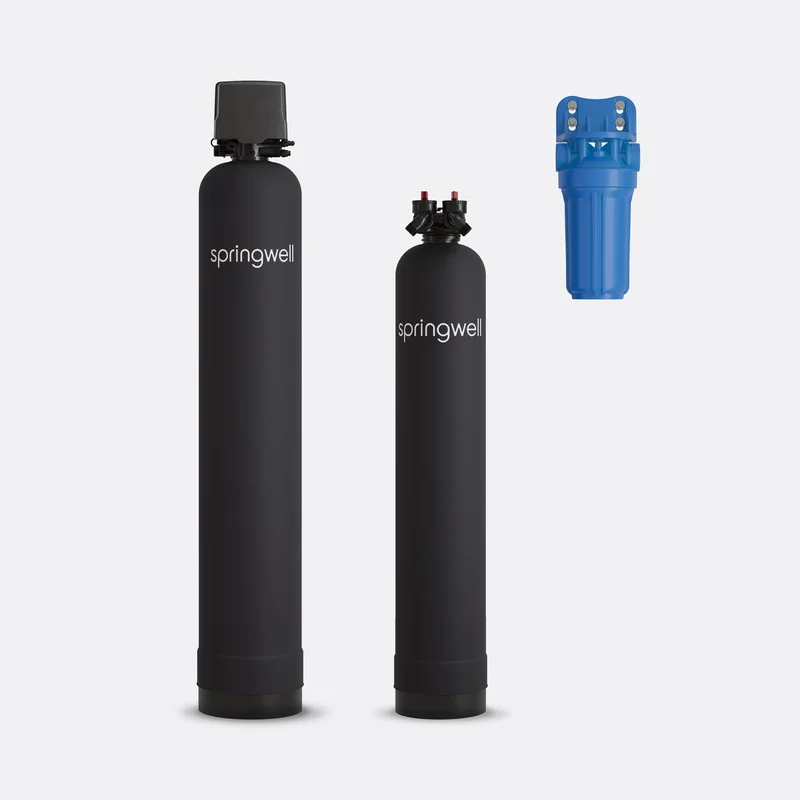
SpringWell · Combination system · $3,213 (sale) at SpringWell as of Oct 2026
- Treats
- Iron, Manganese, Sulfur, Hardness
- Flow
- 12 GPM
- Capacity
- —
- Install
- DIY
- Warranty
- Lifetime
WS1 iron filter plus FS1 salt-free conditioner in one order, both 12 GPM, with lifetime warranty and a $567 saving over separate list prices. Conditioner limits scale but leaves hardness in the water.
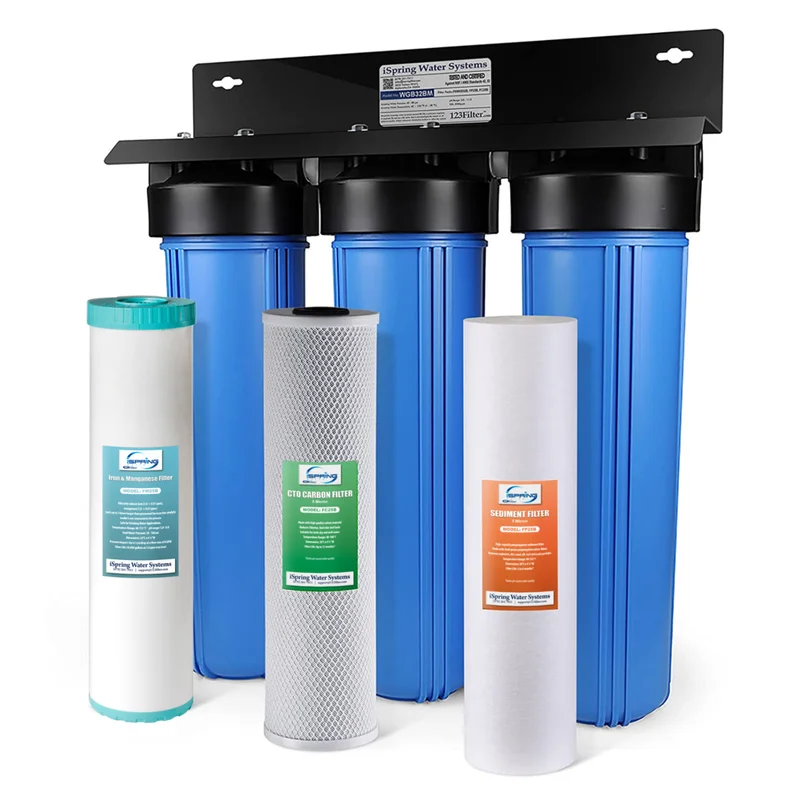
iSpring · Iron filter · $536 at iSpring as of Oct 2026
- Treats
- Iron, Manganese, Sediment
- Flow
- 15 GPM
- Capacity
- 50,000 gal
- Install
- DIY
- Warranty
- 1-year
Three-stage cartridge system with an FM25B cartridge rated for iron to 3 ppm and manganese to 1 ppm, 15 GPM, no drain or power, for $535.99. Iron cartridge lasts 50,000 gallons; no sulfur claim; 1-year warranty.
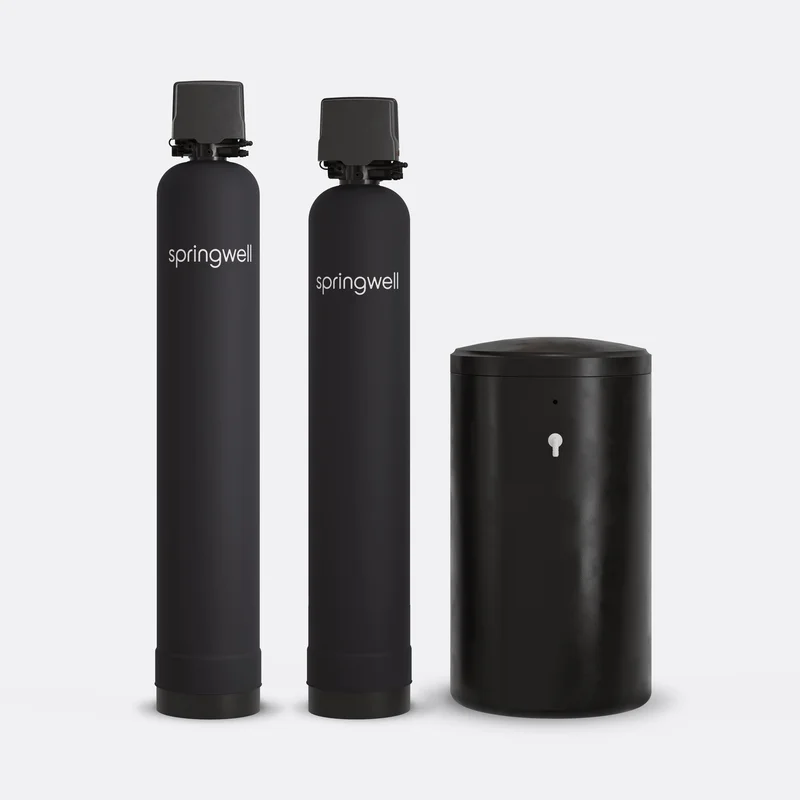
SpringWell · Combination system · $3,124 (sale) at SpringWell as of Oct 2026
- Treats
- Iron, Manganese, Sulfur, Hardness
- Flow
- 11 GPM
- Capacity
- 32,000 gr
- Install
- DIY
- Warranty
- Lifetime
WS1 iron filter plus SS1 32,000-grain softener with Bluetooth heads and a lifetime warranty, $680 less than buying separately. Two drains, two outlets and salt; service flow limited to 11 GPM.
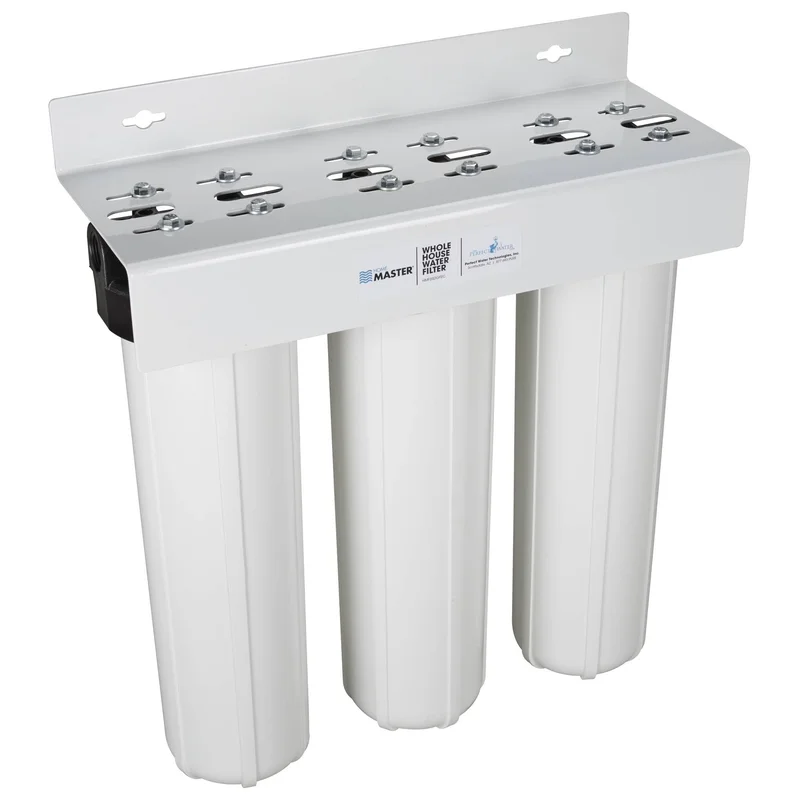
Home Master · Whole-house filter · $550 at Home Master as of Oct 2026
- Treats
- Sediment, Iron, Manganese
- Flow
- 15 GPM
- Capacity
- 100k gal
- Install
- DIY
- Warranty
- 2-year
Three-stage 20 in. cartridge system for well water with a 25-to-1 micron sediment stage, iron cartridge for iron under 3 ppm and 100,000-gallon carbon, 15 GPM, $550. No drain or power; 2-year warranty; not for pH below 7.
Match the filter's rated maximum iron to your lab number with margin to spare, then check that its backwash rate fits your well pump and that your pH is in the media's range. Under the softener's iron rating with hardness to remove, a softener may be enough; above that, an air-injection unit is the usual pick; above 10 mg/L or with iron bacteria, plan on a dealer-installed oxidation system. The sizing tool turns your flow rate and lab results into a tank size.
Before you buy
- Get the lab numbers first: iron, manganese, pH and hardness. The testing guide shows how.
- Confirm the form of the iron with the jar test and rule out iron bacteria with the 24 hour glass test.
- Size the backwash flow to your pump with the sizing tool; a filter your well cannot backwash never cleans itself.
- Compare the ranked systems on the best well water filters page, or use the installer directory to have it plumbed and programmed.
- Retest the treated water after a month and again every year. The only proof an iron filter is working is a follow-up test.