A spin down sediment filter is the cheapest thing you can put on a well that pumps sand, and for a lot of wells it is also the most useful. There is no cartridge. A stainless or polyester screen sits in a housing with a valve on the bottom; when the sump fills with grit you open the valve for ten seconds and it is clean again. That one feature changes the economics of sediment filtration: the screen catches the coarse material that would pack a 5 micron cartridge in a week, so the cartridge behind it lasts months.
For cartridge and backwashing options, read the well water sediment filter guide first.
How a spin down sediment filter works
Water enters the head of the filter at an angle and spins down the inside of the housing. Centrifugal force throws the heavier particles toward the housing wall, where they lose speed and fall into the sump below the screen. At the same time the water passes inward through a cylindrical screen on its way to the outlet, and anything larger than the screen opening stays on the outside.
The University of Florida's irrigation bulletin on emitter plugging describes the same two devices at farm scale and is honest about their limits. Vortex or centrifugal separators "effectively remove sand and larger particles, but are not effective at removing algae, very fine precipitates, and other light-weight materials," and the bulletin recommends them as the first filter on a sand-pumping well, followed by finer filtration. A residential spin-down combines the separator and a screen in one small housing; it inherits both the strength and the limit. Because sand settles below the screen rather than packing against it, the screen stays open longer than a flat strainer would.
Mesh vs. micron
Screens are sold by mesh count, the number of openings per linear inch. Cartridges are sold by micron rating, the size of the particle they stop. The two are related through the wire diameter, so a mesh number only maps to a micron opening for a given wire size. The standard sieve series in ASTM E11 is the reference most charts are based on; UF's screen filter bulletin publishes a similar table for irrigation screens with slightly different values because the wire differs.
| Mesh (openings per inch) | Opening, ASTM E11 (microns) | What it stops |
|---|
| 20 | 850 | Coarse sand, grit, pipe scale |
| 30 | 600 | Coarse sand |
| 40 | 425 | Medium sand |
| 50 | 300 | Medium sand |
| 60 | 250 | Medium to fine sand |
| 80 | 180 | Fine sand |
| 100 | 150 | Fine sand |
| 140 | 106 | Fine to very fine sand |
| 200 | 75 | Very fine sand |
| 270 | 53 | Very fine sand, coarsest silt |
| 325 | 45 | Coarsest silt |
| 400 | 38 | Coarsest silt |
| 500 | 25 | Coarsest silt |
| 635 | 20 | Coarsest silt |
Two things to take from the table. First, the common residential screens (60, 100, 140 and 200 mesh, roughly 250 to 75 microns) all sit inside the USDA sand range of 50 to 2,000 microns (0.05 to 2.0 mm, as defined in the USDA soil texture field guide). They are sand screens. Second, a screen fine enough to touch silt (2 to 50 microns) would need to be 400 mesh or finer, and at that point a screen loads so fast that a cartridge is the better tool. UF's bulletin says it directly: screens are "not normally used to remove particles" in the silt or clay range. If a product is labeled in microns rather than mesh, use the table in reverse.
When a spin-down is enough on its own
A screen alone is the right answer when the problem is coarse and the water is otherwise clean:
- A well that pumps sand but runs clear. If a jar of water drops a layer of grit in a minute and the water above it is clear, you have sand, not silt. A 100 mesh screen fixes it.
- A new well clearing drilling fines. Penn State's well maintenance guide explains that wells not fully developed at drilling keep shedding fines for a while. A spin-down catches the coarse fraction while the well settles down.
- Protecting a pressure tank or irrigation system. Nothing downstream needs silt removed, but sand will wear a pump impeller or a tank bladder; Penn State notes that abrasive sand pumping is the leading cause of pump failure.
In each case the test is the jar. If the water above the settled grit is clear, the screen is enough. If it stays cloudy, you need the next section.
When it is only a pre-filter
Most well treatment trains use the spin-down as stage one and nothing more, for two reasons.
First, it cannot catch what makes water cloudy. Silt and clay pass through a 100 mesh screen as if it were not there, and so does oxidized iron, which Penn State's softening guide warns will clog softener resin. Any softener, iron filter or UV unit downstream still needs a cartridge or media filter in front of it; Penn State's coliform guide is explicit that water entering a UV lamp must be completely free of suspended sediment, and a screen does not get it there.
Second, it is cheap insurance for the cartridge. A 5 micron depth cartridge behind a 100 mesh screen sees only the silt fraction and runs for months; without the screen it takes the sand too and can load in weeks. The two-stage layout is the default for a well with mixed sediment and is covered on the sediment filter guide.
If the water test shows iron, manganese or sulfur, the spin-down is still the first stage, but the real work happens in the oxidizing filter behind it.
Flushing: manual vs. auto-flush
A spin-down only works while the sump has room. Flushing is the maintenance.
Manual flush. With the system pressurized, open the ball valve on the bottom of the housing for five to fifteen seconds and the sump contents blow out. Do it weekly for the first month, watch how fast the sump refills, and settle on an interval from that.
Auto-flush. A small motorized valve on the sump opens on a timer. UF's screen bulletin describes the two automatic approaches used in irrigation: a timer, or a flush "triggered by critical pressure differential across the filter." Residential auto-flush units are timer-based. They cost more and need power and a drain, but they are the right choice when the filter is in a crawl space, a pit, or a second home where nobody will remember to open a valve.
Whichever you use, pipe the flush to a floor drain, a sump pit or outside, not to a bucket someone will forget. Twice a year, shut off the water, unscrew the housing, pull the screen and scrub it with a brush; grit packs into the mesh over time and a flush does not clear all of it.
Clear vs. opaque housings and the algae problem
Most residential spin-downs ship with a clear housing, and it is a real feature: you can see how much sand is in the sump and whether the screen is coated without opening anything. The drawback is light. A clear housing in a sunny pump house or outside on a wall grows green algae on the inside wall and on the screen, and UF's emitter-plugging bulletin lists algae as exactly the kind of light-weight material a centrifugal filter cannot remove.
Two fixes: install the filter where it is dark, or buy an opaque or shielded housing for outdoor and pump-house installs.
Sizing by pipe size and flow
Residential spin-down housings are sold by port size, typically 3/4 in., 1 in., 1-1/2 in. and 2 in., with larger "jumbo" sumps available at each size. Pick the port that matches your main.
Flow matters as much as pipe. Penn State's water system planning guide suggests at least 6 GPM for most single-family homes and lists 10 GPM for a three-bedroom, two-bath house. A spin-down's published flow rating should be at or above your peak household flow with margin, because a partly loaded screen passes less than a clean one. Screen area is the other variable: UF's screen bulletin recommends an open-area-to-pipe-area ratio of 2 or more, which is why the longer jumbo sumps hold pressure better at the same port size. The sizing tool works out peak flow from bathroom count and pump output.
Where to install it
After the pressure tank is the normal position on a residential well. The tank and switch see raw water, the screen protects everything after it, and a loaded screen cannot make the pump short-cycle.
Before the pressure tank is defensible on a well that pumps heavy sand, because the screen's pressure drop is small when clean and it keeps sand out of the tank bladder and the switch. The risk is a neglected screen dropping pressure at the switch and cycling the pump. If you do this, use the largest sump you can fit and flush it on a schedule.
Either way, install it upright so the flush valve is at the lowest point, with a shutoff valve on each side or a three-valve bypass, with the flush valve piped to a drain, and before any cartridge, softener, iron filter or UV. The complete stage order for a well, and why it goes sediment, oxidation, softening, carbon, UV, is on the whole house well water filter page.
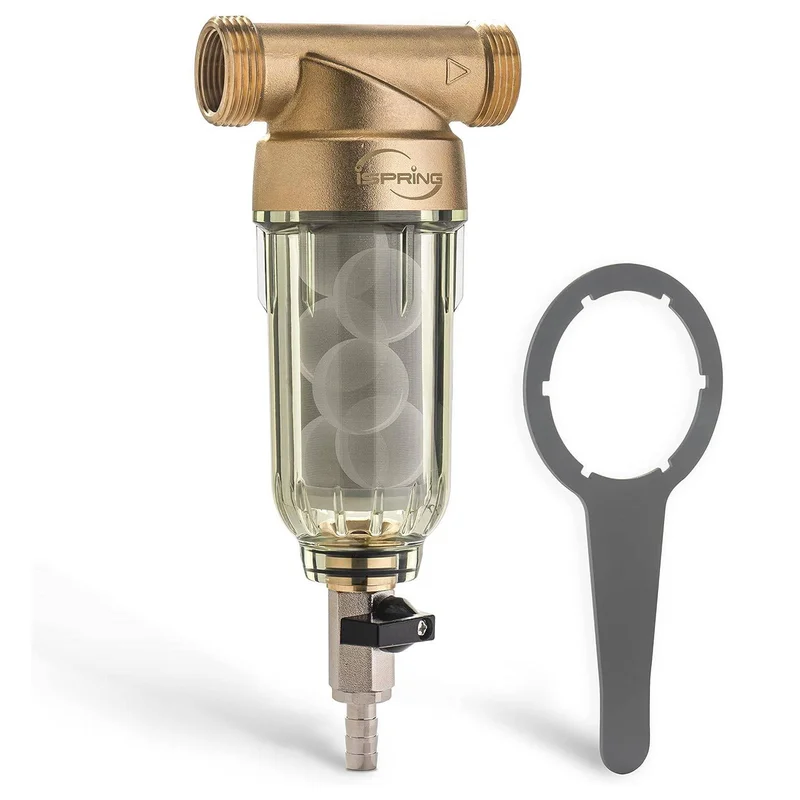 #1
#1iSpring · Sediment filter · $80 at iSpring as of Oct 2026
- Treats
- Sediment
- Flow
- 20 GPM
- Micron
- 50
- Install
- DIY
- Warranty
- 1-year
Spin-down sediment filter plus Siliphos scale-inhibitor cartridge, 20 GPM, 50-micron reusable screen, for $79.99. Siliphos is not a softener and needs replacing every 3-6 months; 100 psi max and 1-year warranty.
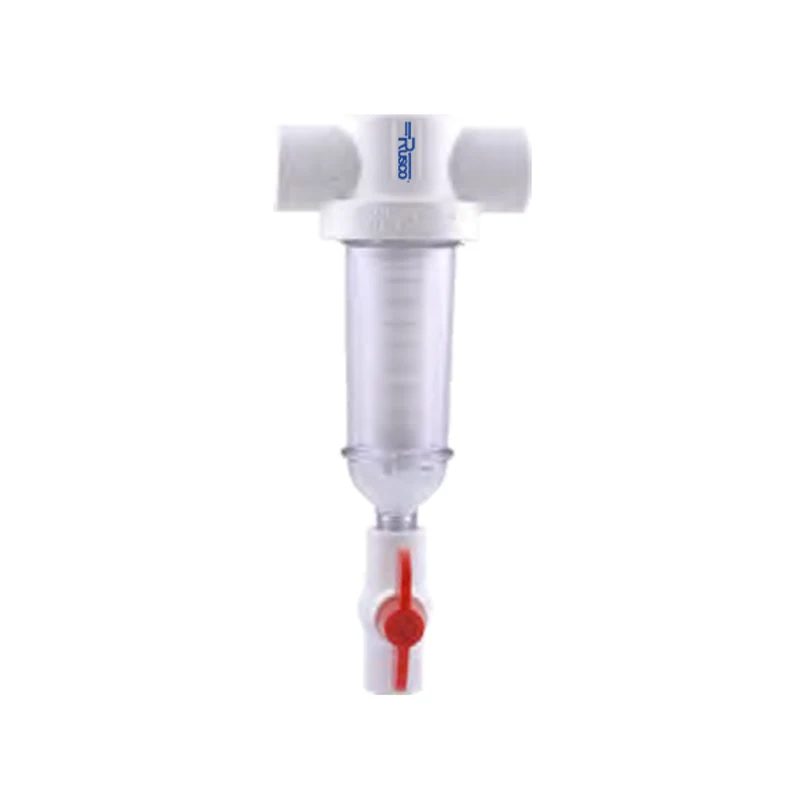 #2
#2Rusco · Sediment filter · $47 at retailer as of Oct 2026
- Treats
- Sediment
- Flow
- 25 GPM
- Micron
- 150
- Install
- DIY or pro
- Warranty
- 1-year
US-made 1 in. spin-down rated 1-25 GPM and 150 psi with flushable polyester or stainless screens from 700 to 15 microns. 12-month warranty, voided by tools; lead-free IAPMO listing only.
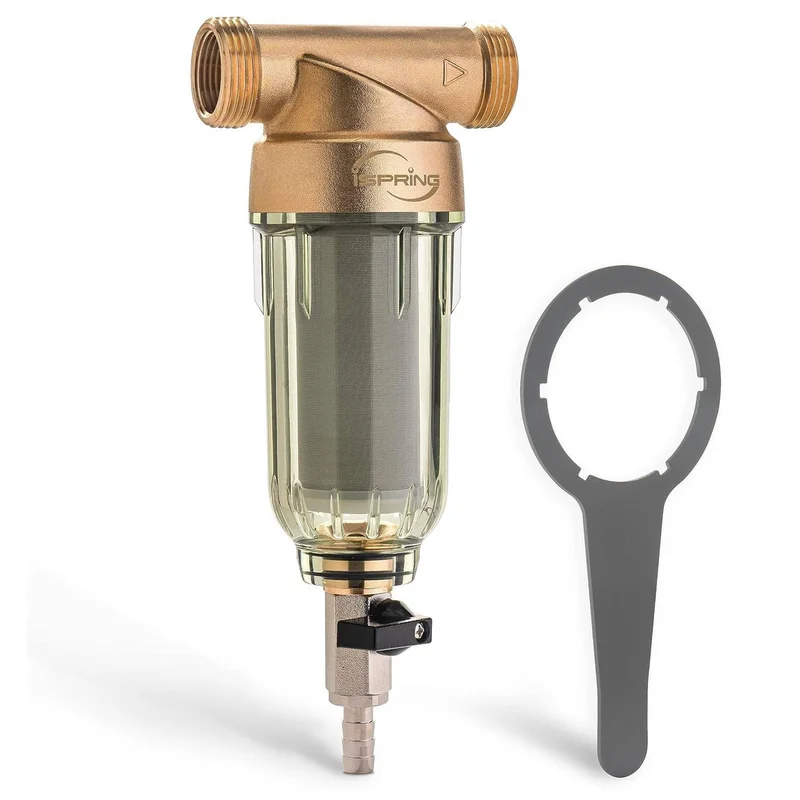 #3
#3iSpring · Sediment filter · $70 at iSpring as of Oct 2026
- Treats
- Sediment
- Flow
- 20 GPM
- Micron
- 50
- Install
- DIY
- Warranty
- 1-year
Flushable 50-micron stainless screen in a clear housing with a 1 in. MNPT / 3/4 in. FNPT brass head, about 20 GPM, for $69.99. No cartridges to buy; too coarse as a final stage and only a 1-year warranty.
The spin-down picks in our data are compared with cartridge and backwashing options on the best well water filters page.
Limits: what a spin-down does not do
The clear housing and the reusable screen make a spin-down look like a complete solution. It is not.
- It does not catch silt or clay. The USDA defines silt as 2 to 50 microns and clay as under 2 microns; even a 200 mesh screen passes almost all of it. Cloudy water stays cloudy.
- It does nothing for bacteria. Bacteria are 1 to 2 microns. See UV for well water.
- It does not reduce turbidity on its own. EPA's public-system turbidity treatment technique of 1 NTU is a reasonable target for a private well, and getting there takes a cartridge or media filter behind the screen.
- It is not a substitute for well repair. A well that pumps sand because of a failed screen or an overpumped formation will keep doing it. Penn State's maintenance guide covers the causes; a well contractor can fix the source.
Before you buy
A spin-down is a cheap, low-risk first stage and almost every sand-pumping well should have one. It is rarely the last stage.
- Test the water and do the jar test, so you know whether the problem is sand (screen), silt (cartridge) or something dissolved.
- Use the sizing tool to get port size and peak flow.
- Compare ranked spin-down, cartridge and backwashing options on the best well water filters page.
- If the well is throwing sand continuously, or the install needs a drain and power for an auto-flush valve, ask a well water installer near you for a quote.