A well water sediment filter is the first thing in the line after the pump and the last thing most people think about. It catches the sand, silt, rust flakes and rock flour the well sends up so that everything downstream (the softener, the iron filter, the UV lamp, the faucet aerators) sees clear water. Get it wrong and you will be changing cartridges every three weeks or watching the pressure fall off every time the washer runs.
If you have not confirmed the problem is sediment rather than iron or tannins, start with the sediment in well water page and a water test.
What sediment is in a well
"Sediment" is a catch-all for anything solid the pump pulls up with the water. Penn State Extension's guide to well maintenance and rehabilitation lists the usual causes: a well not developed enough when it was drilled, no screen in a loose formation, screen openings that are too large, corroding screen or casing, and overpumping beyond the well's design capacity. It also notes that fine particles migrate slowly from the aquifer toward the borehole over the life of a well, which is why a well that ran clear for ten years can start throwing grit.
The USDA soil texture classes, reproduced in a Virginia Department of Health field guide, define sand as 0.05 to 2.0 mm, silt as 0.002 to 0.05 mm, and clay as anything under 0.002 mm. Oxidized iron and manganese come out as a fine red-brown or black powder and are handled on the iron and manganese pages, because the fix there is an oxidizing filter rather than a finer cartridge. The size classes matter because a sediment filter is rated in microns, and sand, silt and clay span more than three orders of magnitude.
Micron ratings: the scale, and nominal vs. absolute
A micron is one-thousandth of a millimeter, and filters are rated by the smallest particle they are designed to stop. The table puts the common targets on one scale: soil classes from the USDA definitions above, bacteria and clay from the University of Georgia's mechanical filtration bulletin, and the two parasites from the CDC's DPDx morphology tables.
| Particle | Size (microns) | Caught by |
|---|
| Coarse to medium sand | 250 to 2,000 | Any spin-down screen |
| Fine and very fine sand | 50 to 250 | 100 to 60 mesh spin-down, or any cartridge |
| Silt | 2 to 50 | 20, 10 or 5 micron cartridge |
| Giardia cysts | 8 to 19 (usually 11 to 12) | 1 micron absolute, NSF/ANSI 53 or 58 |
| Cryptosporidium oocysts | 3 to 6 (usually 4 to 5) | 1 micron absolute, NSF/ANSI 53 or 58 |
| Clay | 0.2 to 2 | Usually not a cartridge job; see below |
| Bacteria | 1 to 2 | Not a sediment filter job; UV or chlorination |
Two ratings get printed on cartridges and they are not the same thing. The CDC's guide to choosing home water filters puts it plainly: with an absolute 1 micron rating, every pore is 1 micron or smaller; with a nominal 1 micron rating, the pores average 1 micron and some larger particles get through. For sand and silt a nominal rating is fine. For parasites it is not, which is why Penn State's Giardia guidance specifies an absolute pore size of 1 micron or smaller, or certification to NSF/ANSI 53 or 58. No sediment filter solves a bacteria problem; see UV for well water.
Colloidal clay passes a 5 micron cartridge and stays suspended for days; a backwashing media filter or a coagulant feed usually works better than a finer cartridge, and that is a job for a local installer.
The three filter types
Spin-down (centrifugal) screens
A spin-down filter is a reusable stainless or polyester screen inside a housing with a flush valve at the bottom. Water enters tangentially and spins, throwing heavier particles down into the sump while the screen stops anything larger than its mesh opening. The University of Florida's irrigation bulletin on emitter plugging describes the same principle at farm scale: centrifugal filters "effectively remove sand and larger particles, but are not effective at removing algae, very fine precipitates, and other light-weight materials," and should be the first filter on a sand-pumping well.
There is no cartridge to buy; you open the valve for a few seconds and the sump flushes to a drain. The mesh-to-micron table, flush options and sizing are on the spin-down filter guide.
Cartridge filters
A cartridge filter is a sealed housing holding a replaceable element. Three constructions dominate:
- Pleated cartridges are surface filters with a lot of area, and the ones to look at when you need an absolute rating. UGA's bulletin notes that pleated cotton/polyester media can be cleaned and reused across a pH of 4 to 9, while pleated paper is the cheapest and is single-use.
- String-wound cartridges are polypropylene yarn wound around a core; particles are caught through the thickness of the winding.
- Melt-blown (spun) depth cartridges are polypropylene fibers blown into a cylinder with, as UGA describes depth filters, "large openings at the outermost surface of the filter, which decrease in size toward the center core." They carry nominal ratings and are the workhorse for silt on a well.
Backwashing media filters
For a well that pumps sediment continuously, cartridges become a weekly expense. A backwashing filter is a mineral tank of graded media (sand, garnet, anthracite or a manufactured granular media) with a control valve that periodically reverses flow and sends the trapped solids to drain. UGA's bulletin describes the layout, coarsest material at the top and finest at the bottom, with backwashing that "reverses the direction of water flow through the filter by forcing water from the bottom of the filter tank and out through the top." UGA's private well treatment overview notes a typical residential sand filter holds an 18 to 24 in. bed.
The trade-off is water. Backwash needs a flow well above the normal service rate (UGA's oxidizing filter bulletin puts it at more than double for media beds of that kind), and the well has to deliver it. Check your pump against the backwash requirement in the sizing tool before buying.
Where the sediment filter goes in the line
After the pressure tank, not before. As a cartridge loads, pressure at the tank drops, the pressure switch sees it, and the pump short-cycles. A spin-down screen is sometimes placed ahead of the tank on a heavily sand-pumping well because its pressure drop is small and it protects the tank bladder, but a cartridge should not be there.
Before the iron filter, softener and UV. Penn State's water softening guide warns that turbid water "may clog the resin with mud and clay" and recommends filtration before softening. Its coliform bacteria guide says water entering a UV unit "must be completely clear and free from any suspended sediment or turbidity," and the Minnesota Department of Health's home water treatment sheet flags pre-filtration for UV once turbidity is above 1 NTU. An under-sink RO also benefits: its small prefilter stops fouling every month.
The full treatment train, and why the order matters stage by stage, is on the whole house well water filter page.
Housing sizes and pressure drop
Residential cartridge housings come in two diameters, 2.5 in. and 4.5 in. (the latter widely called "big blue" after the color most are molded in), and two lengths, 10 in. and 20 in. A 20 x 4.5 in. cartridge holds several times the media of a 10 x 2.5 in. one, which means a lower pressure drop when new and a much longer run before it loads.
A clean cartridge drops a few psi at household flow; a loaded one can drop ten or more. Two rules follow:
- Size the housing to the whole-house flow, not to the pipe. On a 1 in. main feeding more than two bathrooms, the 4.5 in. housing is the default; the 2.5 in. housing is for a single fixture or a small cabin.
- Match the ports to the main. Reducing a 1 in. line to 3/4 in. ports adds a restriction you will feel at every fixture.
Choose a housing with a pressure-relief button; it makes cartridge changes much easier.
Matching flow rate to the pump
The filter has to pass what the household draws at peak, usually two fixtures at once. Penn State's water system planning guide suggests a minimum of 6 GPM from the well for most single-family homes and lists 10 GPM for a three-bedroom, two-bath house. Count bathrooms, check the pump's rated output, and work through the sizing tool before you pick a housing.
Two-stage setups
Most well installations with real sediment end up with two stages: a spin-down screen at 100 to 60 mesh (about 150 to 250 microns) that takes the sand which would otherwise pack a cartridge in days, then a 5 micron depth cartridge in a 20 x 4.5 in. housing that takes the silt and polishes the water for the softener, iron filter or UV. If the well is especially bad, a 20 or 25 micron cartridge between the two cuts the load on the 5 micron stage. A backwashing filter replaces all of it for heavy, continuous loads.
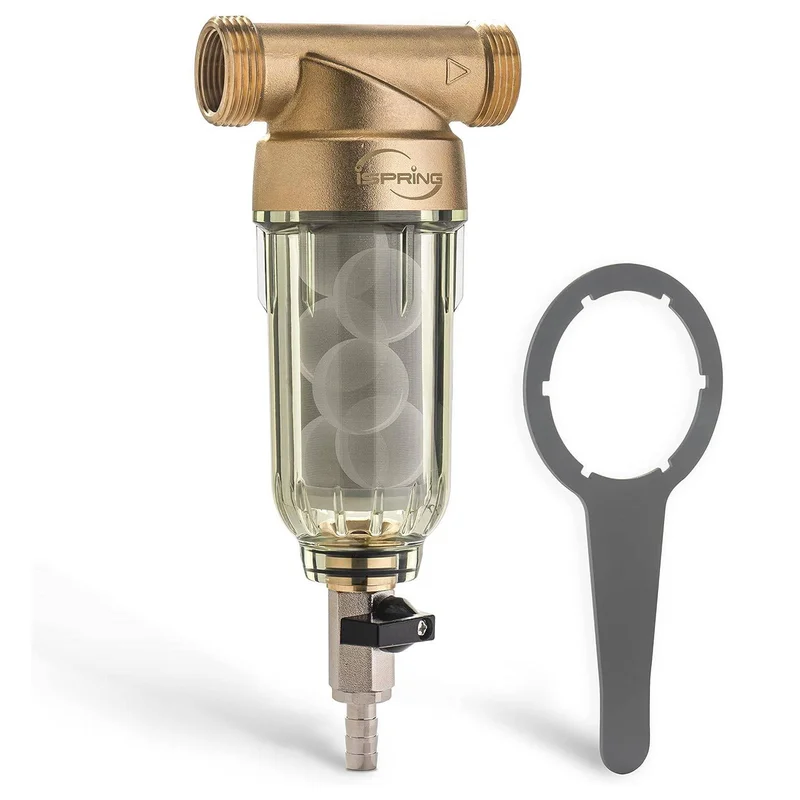 #1
#1iSpring · Sediment filter · $80 at iSpring as of Oct 2026
- Treats
- Sediment
- Flow
- 20 GPM
- Micron
- 50
- Install
- DIY
- Warranty
- 1-year
Spin-down sediment filter plus Siliphos scale-inhibitor cartridge, 20 GPM, 50-micron reusable screen, for $79.99. Siliphos is not a softener and needs replacing every 3-6 months; 100 psi max and 1-year warranty.
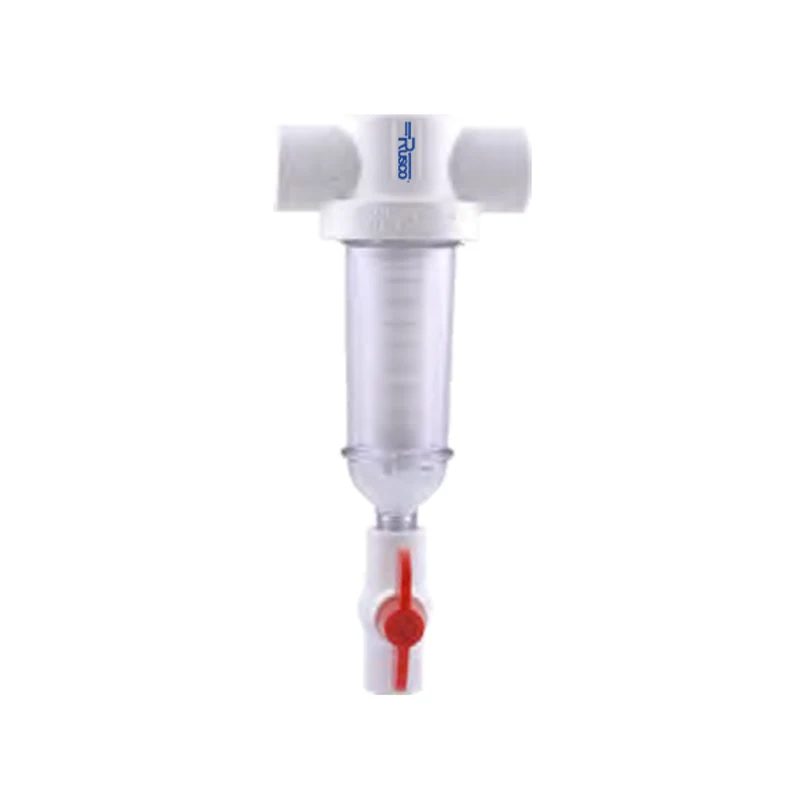 #2
#2Rusco · Sediment filter · $47 at retailer as of Oct 2026
- Treats
- Sediment
- Flow
- 25 GPM
- Micron
- 150
- Install
- DIY or pro
- Warranty
- 1-year
US-made 1 in. spin-down rated 1-25 GPM and 150 psi with flushable polyester or stainless screens from 700 to 15 microns. 12-month warranty, voided by tools; lead-free IAPMO listing only.
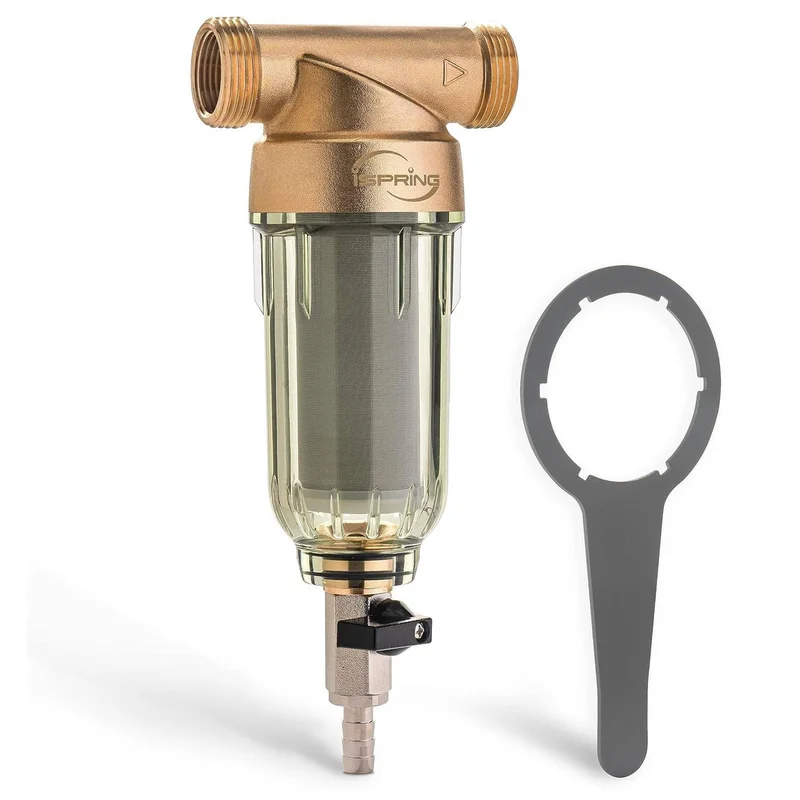 #3
#3iSpring · Sediment filter · $70 at iSpring as of Oct 2026
- Treats
- Sediment
- Flow
- 20 GPM
- Micron
- 50
- Install
- DIY
- Warranty
- 1-year
Flushable 50-micron stainless screen in a clear housing with a 1 in. MNPT / 3/4 in. FNPT brass head, about 20 GPM, for $69.99. No cartridges to buy; too coarse as a final stage and only a 1-year warranty.
The picks above are the current ranked spin-down, cartridge and backwashing options from our data; the best well water filters page explains how they were chosen.
Bypass valves and pressure gauges
A three-valve bypass (inlet, outlet and a bridge between them) lets you change a cartridge or pull a screen without shutting off water to the house. A pair of pressure gauges, one on each side of the housing, tells you when to change the cartridge instead of guessing. One housing manufacturer's service note describes the method: a new cartridge shows a 1 to 3 psi drop at flow, and once the drop grows by another 5 to 7 psi the cartridge is loaded. UGA's rule of thumb is simpler: replace or clean the cartridge "when there is a noticeable drop in water flow." Gauges just make "noticeable" a number.
Maintenance
- Flush the spin-down weekly at first, then as often as the sump shows a layer of sand. Scrub the screen a few times a year.
- Change cartridges on pressure drop or time, whichever comes first. Many wells land at three to six months on a 5 micron depth cartridge behind a screen. The procedure, O-ring care and standard cartridge sizes are on the sediment filter replacement page.
- Do not run a spent cartridge. UGA's well treatment overview warns that a spent filter "may be worse than no filter at all" because bacteria can grow in it; the Minnesota Department of Health says the same of any unmaintained unit.
- Check the backwash cycle on a media filter once a season: listen for it at the programmed time and confirm water reaches the drain.
Before you buy
A sediment filter does not treat anything dissolved; water that turns orange after sitting is not a sediment problem.
- Test the water for turbidity, iron, manganese and bacteria, so you know what you are filtering.
- Run the sizing tool with your bathroom count and pump output to get a housing size and flow target.
- Compare the ranked systems on the best well water filters page.
- If the well pumps sand continuously, or you need a backwashing filter and a drain, get a quote from a well water installer near you.