A positive total coliform or E. coli result is the one well water problem you cannot see, smell or taste. The one-sentence answer: stop drinking the water until it tests clean, inspect and shock chlorinate the well, retest, and only if bacteria keep coming back install a UV filter for well water that is certified to NSF/ANSI 55 Class A, with the pre-treatment it needs to work. A UV unit bought before the well is fixed treats a symptom while the entry point stays open.
What causes bacteria in well water
Coliform bacteria live on the ground surface and in the gut of warm-blooded animals. The Minnesota Department of Health explains that they are everywhere on the surface but do not usually occur past a few feet into the soil, which is why their presence in a well means something at the surface has found a path in. The usual paths: a cracked, buried or loose well cap; a casing that ends below grade or has corroded through; a failed grout seal; a septic drainfield, barnyard or manure pile within reach; flooding over the wellhead; or a pump or plumbing repair done without disinfecting afterward.
Penn State Extension cites a 2006 survey that found coliform in about 35 percent of Pennsylvania private wells and E. coli in about 15 percent; shallow dug and bored wells and old wells with short casings are the most exposed.
How to tell total coliform from E. coli
Total coliform is an indicator group. Most of its organisms are harmless, but Penn State describes a positive as a sign that a contamination pathway exists and that disease-causing bacteria could enter the same way. The EPA's Revised Total Coliform Rule treats it the same way for public systems: a positive is not a health violation on its own but a trigger for repeat samples and an assessment that finds and fixes the sanitary defect.
E. coli is a fecal coliform. The CDC says a positive fecal coliform or E. coli result indicates fecal contamination has entered the well, and Penn State calls it much more serious than coliform alone. Under the EPA rule, E. coli has a maximum contaminant level goal of zero.
High nitrate alongside bacteria supports a septic or livestock source. Slime, odor or black staining point to iron and sulfur bacteria, a nuisance rather than a health risk.
Is it a health risk?
Yes. Minnesota DOH lists the illnesses carried by fecally contaminated water as diarrheas, dysenteries, salmonellosis, hepatitis and giardiasis, with infants, children, the elderly and the immunocompromised at highest risk. The EPA and the CDC both tell private well owners to test for total coliform at least once a year, and to retest after flooding, after work on the well, when a child joins the household or when the water changes.
If E. coli is present, do not drink the water; the CDC's interim advice is a rolling boil for one minute, or bottled water, until the well tests clean. Minnesota DOH adds: if the water also has high nitrate or arsenic, do not boil it, since boiling concentrates them.
How to test for bacteria in well water
- Get a sterile bottle from a certified lab. Bacteria tests need a sterile bottle and a short holding time (usually 24 to 30 hours, kept cold). Ask your state or county health department for the list of certified labs; many counties offer low-cost coliform tests.
- Sample correctly. Use a cold tap without an aerator, ahead of any treatment. Flush for several minutes, do not touch the inside of the bottle or cap, fill to the line and deliver it within the lab's holding time.
- Act on a positive result. If E. coli is present, stop drinking the water or bring it to a rolling boil for one minute (three minutes above 6,500 ft) until a follow-up test taken at least a week after disinfection comes back clean; a second test a few months later confirms the fix held. Total coliform alone is a warning that the well is open to surface contamination.
- Shock chlorinate and retest. Inspect the well cap, casing and grading first. Shock chlorinate following your state extension office's procedure, flush the chlorine out, wait at least a week and retest. Repeated positives mean the well itself needs repair or continuous disinfection such as UV.
- Test every year. EPA and CDC recommend testing private wells for coliform bacteria at least once a year, and after flooding or any repair.
Our testing guide covers finding a certified lab.
Treatment options
Fix the well, then shock chlorinate
Most bacteria problems end here, and it is contractor work rather than a product. Replace a damaged cap with a sanitary vermin-proof cap, extend a short casing above grade, regrade so water runs away from the well, and fix the septic component if that is the source. Then disinfect.
Virginia Cooperative Extension's shock chlorination procedure targets about 200 ppm of chlorine in the well and plumbing; the bleach volume depends on casing diameter and water depth, so read its dosing table first. Bypass any softener, carbon filter or UV unit, since Penn State warns high chlorine can damage or exhaust them; pour the measured bleach, mixed with water, into the well and recirculate it with a hose until every faucet smells of chlorine; let it stand 12 to 24 hours; then flush it out through outside faucets onto ground where it will not harm plants, reach a stream or load the septic system. The CDC's disinfection guidance says to wait at least 7 to 10 days after disinfection and then retest; Penn State suggests retesting 10 to 14 days later and again two to three months on.
Penn State reports that shock chlorination permanently solved the problem in only about 15 percent of wells with coliform, and worked best on wells with fewer than 10 colonies per 100 mL and no E. coli. If bacteria return, Virginia Tech and Penn State say the same thing: a continuous source is present and continuous disinfection is required.
UV disinfection system
A UV lamp inside a quartz sleeve in a stainless chamber. The light damages the genetic material of bacteria, viruses and protozoa so they cannot reproduce. Nothing is added or removed: there is no residual, and it only works on water clear enough for the light to pass through.
Class A, not Class B. NSF/ANSI 55 is the standard the NSF applies to UV systems, and it has two classes. The WQA's UV fact sheet lays them out: Class A systems deliver a minimum dose of 40 mJ/cm2, are designed for water of unknown quality and may claim to disinfect water contaminated with bacteria, viruses, Cryptosporidium or Giardia, and must include a UV sensor and alarm. Class B systems deliver 16 mJ/cm2 and are for supplemental treatment of water already deemed safe by a health agency. Ohio's Department of Health UV fact sheet says Class B and unrated units are not intended for microbiologically unsafe water and calls anything but Class A for primary disinfection of a private well hazardous. For a well that has tested positive, buy Class A, sized so its rated flow meets your peak flow.
Pre-treatment is not optional. Ohio DOH recommends pre-filtration when turbidity reaches 5 NTU or suspended solids exceed 10 ppm, and says to treat the water before UV when dissolved iron is 0.3 ppm or higher or hardness is 6 gpg or higher, because both coat the quartz sleeve and block the light. In practice:
- A 5 micron sediment filter immediately ahead of the UV chamber, on every installation.
- An iron filter if iron is at or above 0.3 mg/L (the same number as the EPA secondary standard).
- A softener if hardness is above about 6 to 7 gpg, or a plan to clean the sleeve monthly.
- A UV transmittance (UVT) test on the raw water before selecting a unit; WQA notes clear-looking water can have low UVT from dissolved organics and metals. Tannin-colored water is the common failure.
Penn State adds a ceiling: UV is not recommended where total coliform exceeds 1,000 colonies per 100 mL or fecal coliform exceeds 100 per 100 mL; a well that dirty needs chlorination. Maintenance is a new lamp every year (WQA gives about 10,000 hours of useful life; Ohio DOH says replace annually before the alarm trips), sleeve cleaning on a schedule set by your hardness, and a new sleeve every 3 to 5 years. UV goes last, after every filter and the softener.
Continuous chlorination
A feed pump doses chlorine into a retention tank ahead of a carbon filter that removes the residual before the house. Penn State describes maintaining 0.3 to 0.5 mg/L of residual chlorine with about 30 minutes of contact time. It is the answer for wells too contaminated for UV, for springs, for wells that cannot be sealed and for water that also has iron or sulfur bacteria to oxidize. Dealer-installed, with chlorine to refill and carbon to replace.
Systems that treat bacteria in well water
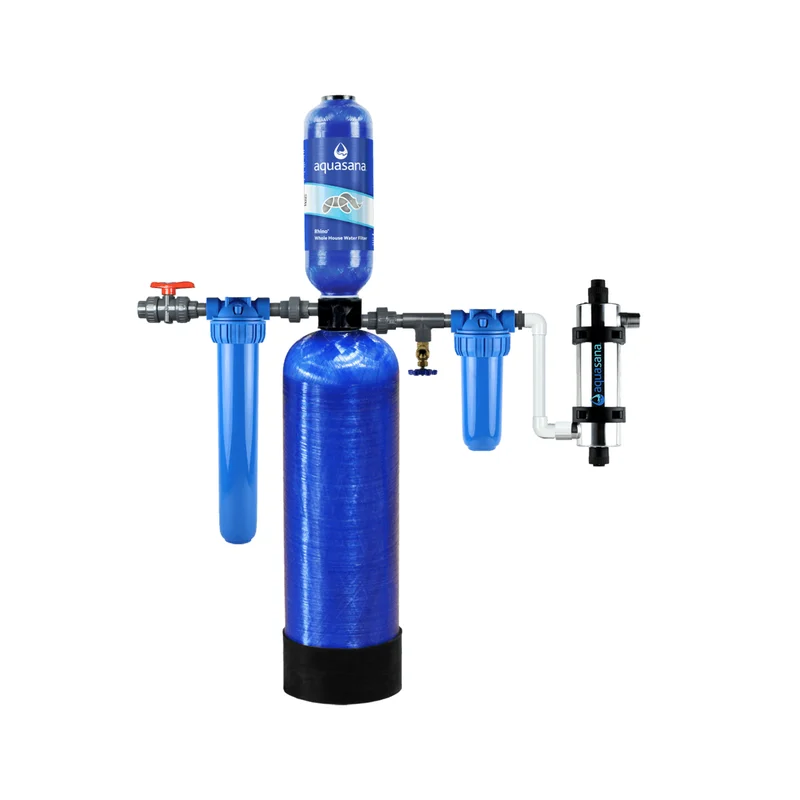
Aquasana · Whole-house filter · $1,749 (sale) at Aquasana as of Oct 2026
- Treats
- Bacteria, Sediment
- Flow
- 7 GPM
- Capacity
- 500k gal
- Install
- DIY or pro
- Warranty
- 5-year
Carbon and KDF whole-house tank with an NSF/ANSI 55 Class B certified UV stage, 500,000-gallon media life and no backwash. No iron or sulfur claim; 7 GPM rated flow and pre-filter changes every 2 months.
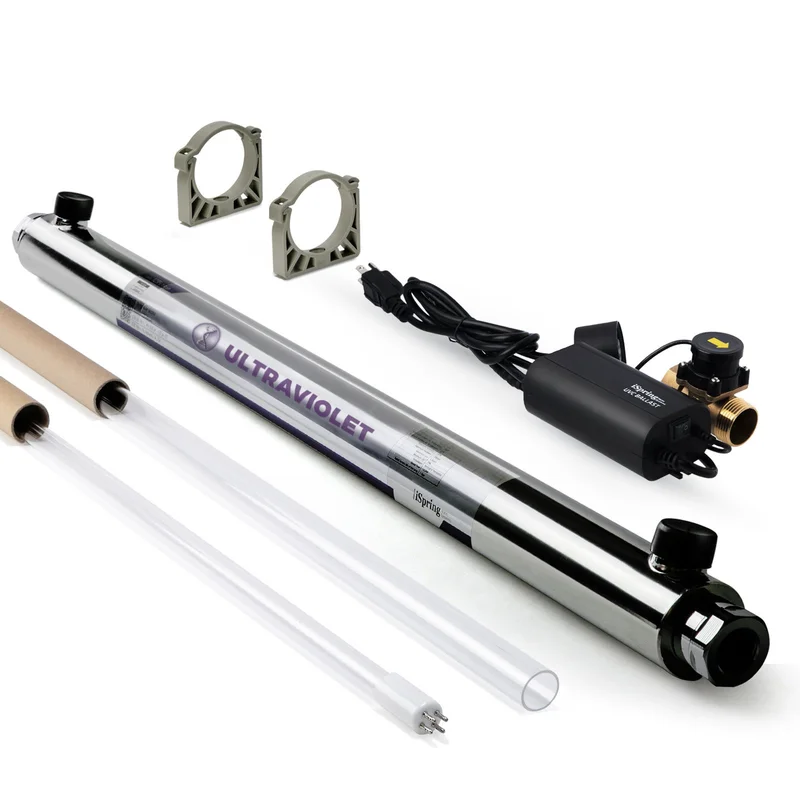
iSpring · UV disinfection · $339 at iSpring as of Oct 2026
- Treats
- Bacteria
- Flow
- 12 GPM
- Capacity
- —
- Install
- DIY
- Warranty
- 1-year
55 W UV sterilizer rated 12 GPM with a flow-sensing ballast and 9,000-hour lamp for $338.99. No NSF/ANSI 55 certification or published dose; 1-year warranty; needs pre-treated water.
Pentair · UV disinfection · Check current price
- Treats
- Bacteria
- Flow
- 10 GPM
- Capacity
- —
- Install
- Professional
- Warranty
- 3-year
10 GPM UV certified to NSF/ANSI 55 Class A with a dose sensor that shuts off flow below 75%, 10-year chamber warranty. Price not shown on the page; professional install recommended; needs 5-micron pre-filtration.
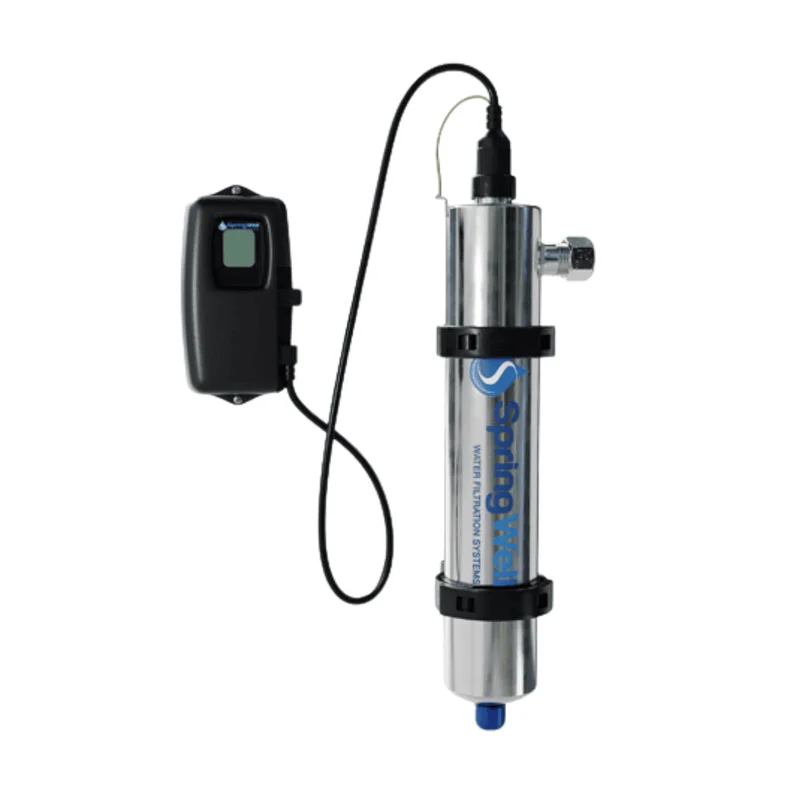
SpringWell · UV disinfection · $1,101 (sale) at SpringWell as of Oct 2026
- Treats
- Bacteria
- Flow
- 15 GPM
- Capacity
- —
- Install
- DIY
- Warranty
- 10-year
15 GPM UV-C reactor with a lamp-life countdown and alerts, 10-year reactor warranty per the manual, and about $200 a year in lamp and sleeve. No NSF/ANSI 55 certification or published dose; needs pre-treated water.
Choose a Class A unit whose flow rating covers your peak demand, then build the pre-treatment from your lab results: a sediment cartridge always, an iron filter above 0.3 mg/L, a softener above about 6 to 7 gpg. Combination systems that package sediment, carbon and UV together suit low-iron wells. The sizing tool gives you the flow number to match.
Before you buy
- Confirm the positive with a second certified-lab sample, then test iron, manganese, hardness, turbidity and UVT to learn what pre-treatment the UV needs (testing guide).
- Inspect and shock the well first; a sealed well may not need a UV unit at all.
- Compare Class A UV units and combo systems on the best well water filters list and size them with the sizing tool.
- Well repairs and chlorination systems are contractor work; find a local installer.
- Retest for total coliform and E. coli after installation, and every year after.