You will not see, smell or taste PFAS in well water. A well owner finds out from a lab report in parts per trillion, usually ordered because a military base, airport, landfill or factory sits nearby. The short answer: test with a lab that runs EPA Method 537.1 or 533, compare the result to the EPA's 4.0 ppt limits for PFOA and PFOS, and if you are over, put a reverse osmosis or carbon system with an NSF/ANSI 53 or 58 PFOA/PFOS certificate on the drinking tap and retest.
What causes PFAS in well water
PFAS (per- and polyfluoroalkyl substances) are manufactured chemicals used since the 1940s because they repel oil and water and resist heat. They do not break down in groundwater, which is why a plume can travel a long way from where it started.
The EPA's private-well PFAS page lists the usual sources: fire extinguishing foam, manufacturing facility waste, contaminated waste sites, and biosolids spread on fields. Aqueous film-forming foam (AFFF) is the one that matters most to rural wells; it was used for decades at military bases, airports and fire-training grounds, and its plumes move with the aquifer into private wells that have nothing else wrong with them. None of this is natural geology, which is why your neighbor's test predicts more than your well depth does.
How to tell PFAS from other well problems
There is no lookalike. Unlike iron, sulfur or tannins, PFAS leave no stain, odor or color at the concentrations that matter. A well with clear, good-tasting water can be well over the limit, and a well with orange staining can be PFAS-free.
The useful screen is geography: an airfield, a base, a fire-training site, a landfill, a plating or textile plant, or fields that receive biosolids within a few miles. If any apply, order the test. If none do and your state has no detections nearby, spend the money on the annual coliform and nitrate test first.
Is it a health risk?
Yes, and it is one of the few well-water problems where the federal number is both recent and still moving.
On April 10, 2024 the EPA finalized the first National Primary Drinking Water Regulation for PFAS. It set enforceable Maximum Contaminant Levels (MCLs) of 4.0 ppt for PFOA and 4.0 ppt for PFOS; 10 ppt each for PFHxS, PFNA and HFPO-DA (GenX chemicals); and a hazard index of 1 for mixtures of PFHxS, PFNA, HFPO-DA and PFBS.
On May 14, 2025 the EPA announced it would keep the PFOA and PFOS limits at 4.0 ppt, push the compliance deadline from 2029 to 2031, and rescind and reconsider the other three limits and the hazard index. On May 18, 2026 it published the two proposed rules to do that, a compliance extension rule and a rescission rule. Comments closed July 20, 2026 and, as of October 2026, neither is final, so the full 2024 rule remains on the books.
Keep two things straight. Every one of these numbers applies to public water systems; the EPA says it does not regulate private wells, and well owners are responsible for their own water. And the limits are still the right yardstick: 4.0 ppt for PFOA or PFOS is the number to compare your lab report against, along with your state standard if there is one.
| Compound | April 2024 MCL | Status as of October 2026 |
|---|
| PFOA | 4.0 ppt | Kept; extension to 2031 proposed May 2026, not final |
| PFOS | 4.0 ppt | Kept; extension to 2031 proposed May 2026, not final |
| PFHxS, PFNA, HFPO-DA | 10 ppt each | Rescission proposed May 2026, not final; still in force |
| Hazard index (PFHxS, PFNA, HFPO-DA, PFBS) | 1 | Rescission proposed May 2026, not final; still in force |
How to test for PFAS
A home kit cannot measure parts per trillion. The EPA tells well owners to ask their state environmental or health agency for state-certified labs using EPA-developed methods.
- Check whether testing is warranted. Look at your state's PFAS sampling map and ask the county health department whether wells nearby have been tested. If a source is within a few miles, test.
- Use a lab accredited for EPA Method 537.1 or 533. Only a certified lab with a PFAS-specific method can report at the parts-per-trillion level. Expect a cost in the low hundreds of dollars. Follow the sampling instructions exactly; PFAS are in many consumer products and samples are easy to contaminate.
- Compare to the EPA limits. The 2024 rule set enforceable limits of 4.0 ppt for PFOA and for PFOS, and 10 ppt each for PFHxS, PFNA and HFPO-DA, for public water systems; EPA proposed in May 2026 to keep the PFOA and PFOS limits and rescind the others, but nothing is final as of October 2026. Private wells are not regulated, but these are the numbers to compare against.
- Choose a certified treatment. Look for NSF/ANSI 53 (carbon) or NSF/ANSI 58 (reverse osmosis) certification with PFOA/PFOS reduction claims on the certificate, not just 'tested to'. Retest treated water after installation and on the maker's media-replacement schedule.
Order PFBS alongside the five regulated compounds, plus total organic carbon and hardness, which affect filter choice. Sample ahead of any existing treatment and keep the report; you will need the influent numbers to pick and size a system. Our well water testing guide covers labs and sampling.
Treatment options
Three technologies are proven: granular activated carbon, anion exchange resin, and high-pressure membranes (reverse osmosis and nanofiltration). Per the EPA, GAC works well on longer-chain PFAS like PFOA and PFOS, shorter chains such as PFBS and PFBA do not adsorb as well, and RO and nanofiltration are typically more than 90 percent effective across a wide range of PFAS including the short chains.
Reverse osmosis (under-sink)
An under-sink RO unit on the kitchen tap is the default answer for a private well. It handles short-chain PFAS that carbon misses, and the EPA's own point-of-use testing found RO effluent below 3 ppt on two of the three systems tested. Look for NSF/ANSI 58 with PFOA and PFOS reduction on the certificate. It needs a sediment prefilter, and hard water or iron should be treated upstream or the membrane fouls early. Replace prefilters and the membrane on the maker's schedule. Whole-house RO exists but is expensive and wastes water.
Granular activated carbon (whole-house or point-of-use)
A GAC tank at the point of entry treats every tap. It works best on PFOA and PFOS, the two compounds the EPA intends to keep regulating, and it needs contact time, so a tank sized to your flow rate matters more than brand. The problem is breakthrough: you cannot see or smell when the carbon is spent, so the replacement schedule has to come from a PFAS retest, not a calendar. The EPA's home filter fact sheet warns that not replacing a filter on schedule can increase your exposure. Look for NSF/ANSI 53 with PFOA and PFOS reduction. Put a sediment filter ahead of it and remove iron first.
Anion exchange
Specialty resin with very high PFAS capacity, used in municipal plants and some whole-house systems. Per the EPA it can remove 100 percent of the PFAS for a time and is typically more expensive than GAC. The resin is single-use, so ask about the disposal plan. Dealer-installed.
What does not work
The Minnesota Department of Health says it directly: water softeners and iron filters are not likely to remove PFAS, and boiling will not remove PFAS. Boiling concentrates them. A plain sediment cartridge does nothing.
What NSF/ANSI 53 and 58 actually certify
NSF/ANSI 53 covers health-effects claims for carbon and anion-exchange filters; NSF/ANSI 58 covers reverse osmosis systems. A PFOA/PFOS reduction claim is a specific line on the certificate, not something implied by the standard number. NSF's protocol document says certification verifies the PFOA and PFOS reduction claims on the label, that the system adds nothing harmful and is structurally sound, and that its literature is not misleading. Penn State Extension adds the number that matters: a certified unit must reduce PFOA and PFOS to a combined concentration of 20 ng/L (20 ppt).
That is above the 4.0 ppt MCL, and both the EPA fact sheet and Penn State say so: current certification does not indicate that a filter will lower PFAS to the new limits. Certification tells you the unit does what the label says under a standardized test; your retest tells you whether it gets your water under 4 ppt.
"Tested to NSF/ANSI 53" or "meets NSF standards" on a box is not certification; it means the manufacturer, or a lab of its choosing, ran some version of the test. Certification means an accredited body (the EPA names NSF, WQA, IAPMO, UL and CSA) tested the model, inspects the factory and lists the product with its specific claims. The NSF listing search filters by "PFOA Reduction," "PFOS Reduction" and "Total PFAS Reduction." No listing, no certification.
Systems that treat PFAS
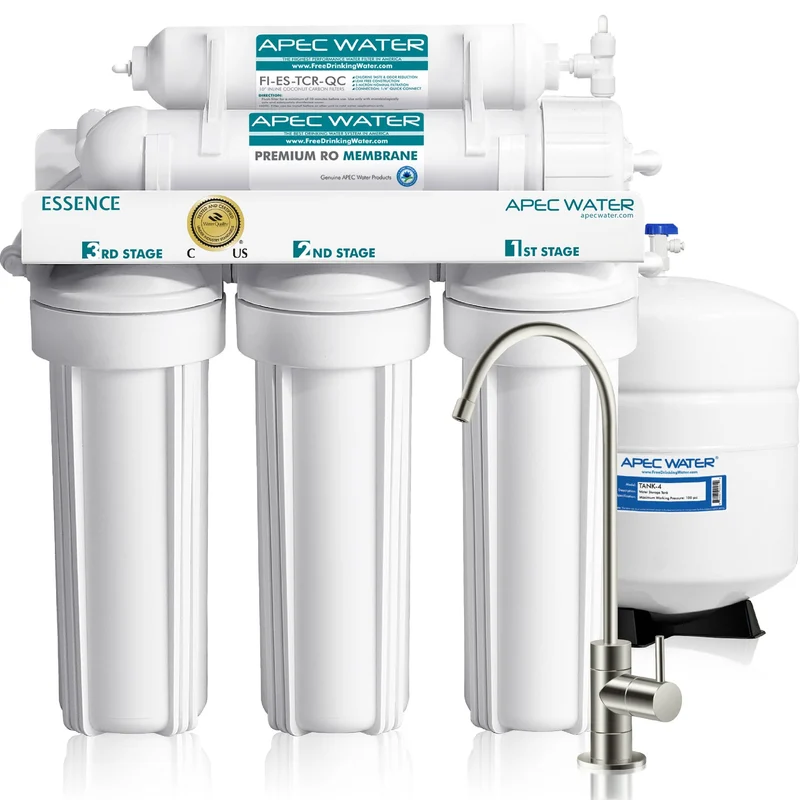
APEC Water Systems · Reverse osmosis · $231 at APEC Water Systems as of Oct 2026
- Treats
- Nitrates, PFAS
- Flow
- —
- Capacity
- —
- Install
- DIY
- Warranty
- 1-year
Five-stage under-sink RO rated 50 GPD, WQA Gold Seal system (NSF/ANSI 58, TDS reduction) with tank and faucet, $230.99. Nitrate and PFAS reduction are maker claims; 1-year warranty.
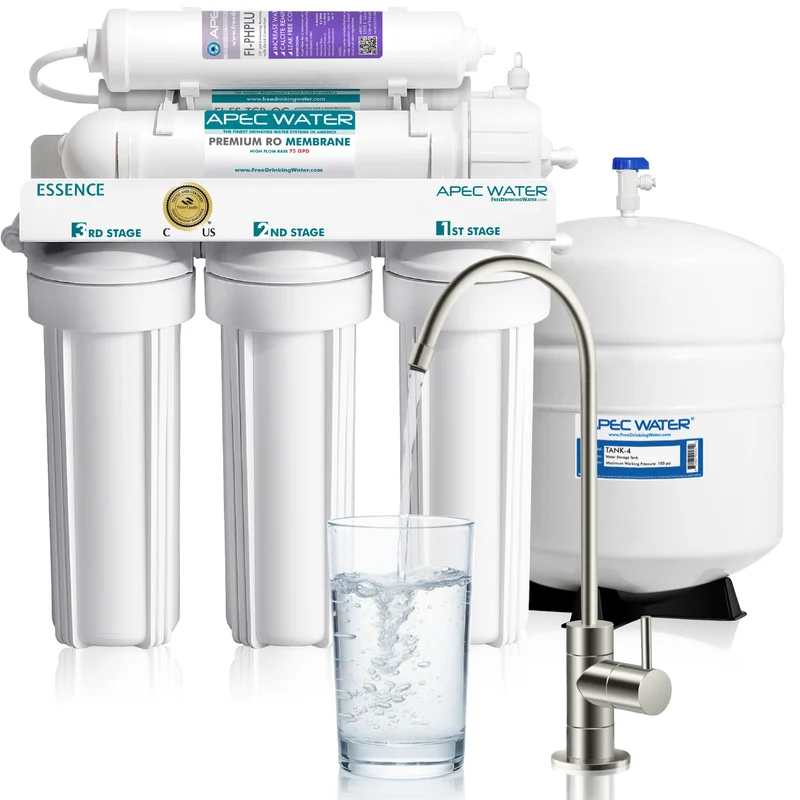
APEC Water Systems · Reverse osmosis · $269 at APEC Water Systems as of Oct 2026
- Treats
- Nitrates, PFAS
- Flow
- —
- Capacity
- —
- Install
- DIY
- Warranty
- 1-year
Six-stage under-sink RO rated 75 GPD with a calcite pH stage, WQA Gold Seal system (NSF/ANSI 58, TDS reduction), $268.99 with tank and faucet. Nitrate and PFAS are maker claims; 1-year warranty.
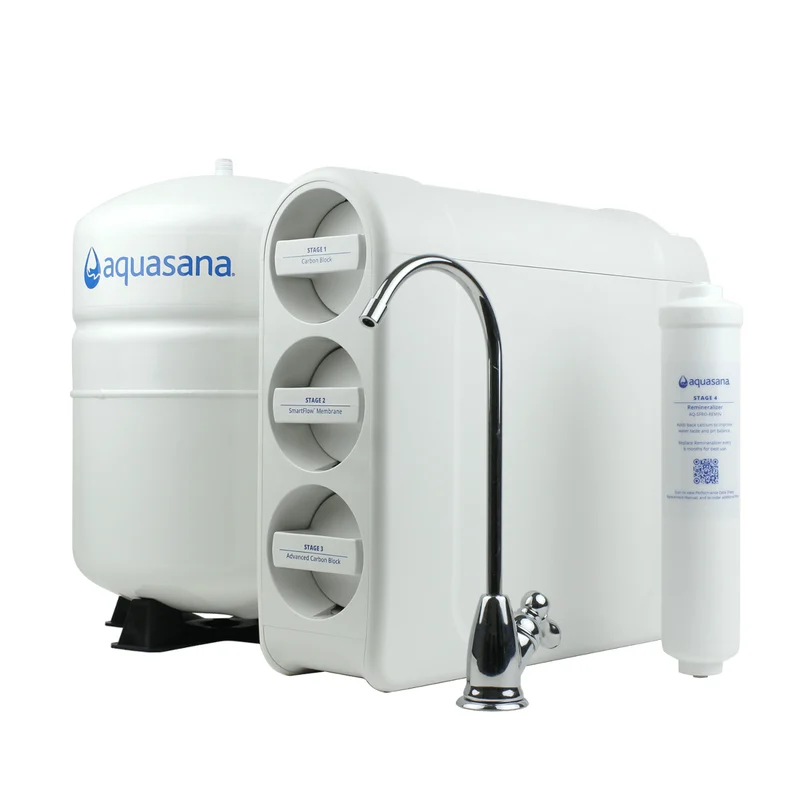
Aquasana · Reverse osmosis · $225 (sale) at Aquasana as of Oct 2026
- Treats
- Nitrates, PFAS
- Flow
- 0.7 GPM
- Capacity
- 250 gal
- Install
- DIY or pro
- Warranty
- 2-year
Under-sink RO certified by WQA to NSF/ANSI 42, 53, 58 and 401, including nitrate/nitrite (78%) and PFOA/PFOS. 0.7 GPM faucet flow, 25.7 GPD, $224.99 on sale. Cartridges last 250 gallons or 6 months.
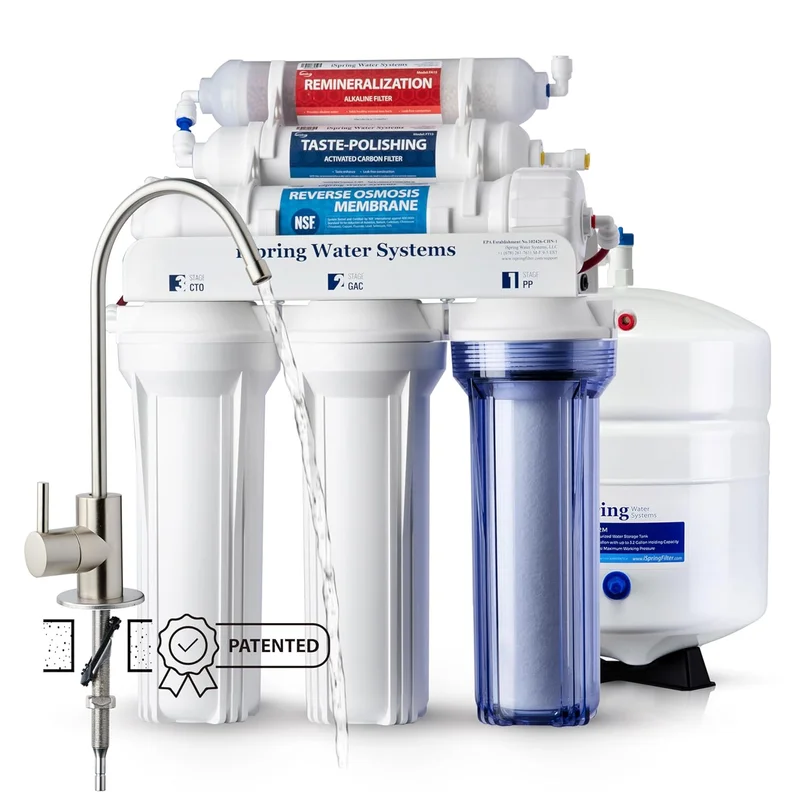
iSpring · Reverse osmosis · $242 at iSpring as of Oct 2026
- Treats
- PFAS
- Flow
- —
- Capacity
- —
- Install
- DIY
- Warranty
- 1-year
Six-stage under-sink RO rated 75 GPD, NSF-listed to NSF/ANSI 58 for TDS reduction, $241.99; iSpring's fluoride and lead figures are NSF-listed for the -BN/-BLK variants. PFAS is a maker claim; no nitrate claim; 1-year warranty on registration.
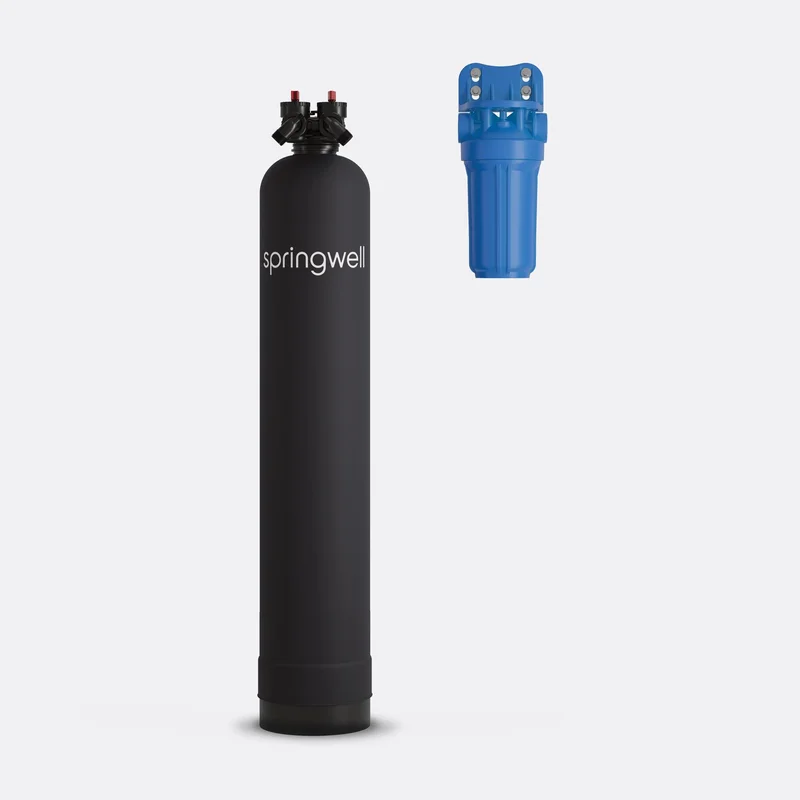
SpringWell · Whole-house filter · $1,160 (sale) at SpringWell as of Oct 2026
- Treats
- PFAS
- Flow
- 9 GPM
- Capacity
- 1,000k gal
- Install
- DIY
- Warranty
- Lifetime
KDF and catalytic carbon tank rated 9 GPM with a 1,000,000-gallon media life, no drain or power and a lifetime warranty. Marketed for city water; PFAS reduction is a maker claim with no certification.
If the only concern is drinking and cooking, an NSF/ANSI 58 under-sink RO is the cheapest reliable fix and handles short-chain compounds. If you want every tap treated, or you have high PFOA/PFOS and want a second barrier, add a certified whole-house GAC tank sized to your flow, with sediment and iron handled first. Run the numbers in the sizing tool so a carbon tank gets the contact time it needs.
Before you buy
Get the lab report in hand, including hardness, iron and TOC, before you shop; dealers size PFAS systems from those numbers. Compare certified units on the best well water filters page, size any whole-house stage with the sizing tool, and read how to test well water so before-and-after samples are done right. A licensed installer will set the order correctly: sediment, iron, softener, PFAS treatment, then UV if you need it. Retest after installation and again on the media-replacement interval; with PFAS, the retest is the only gauge you have.